Down syndrome
Down syndrome is a lifelong genetic condition. A person has an extra copy of chromosome 21, which changes how the body and brain develop. Every person's abilities are different, and with good care many people with Down syndrome now live into their 60s or longer.
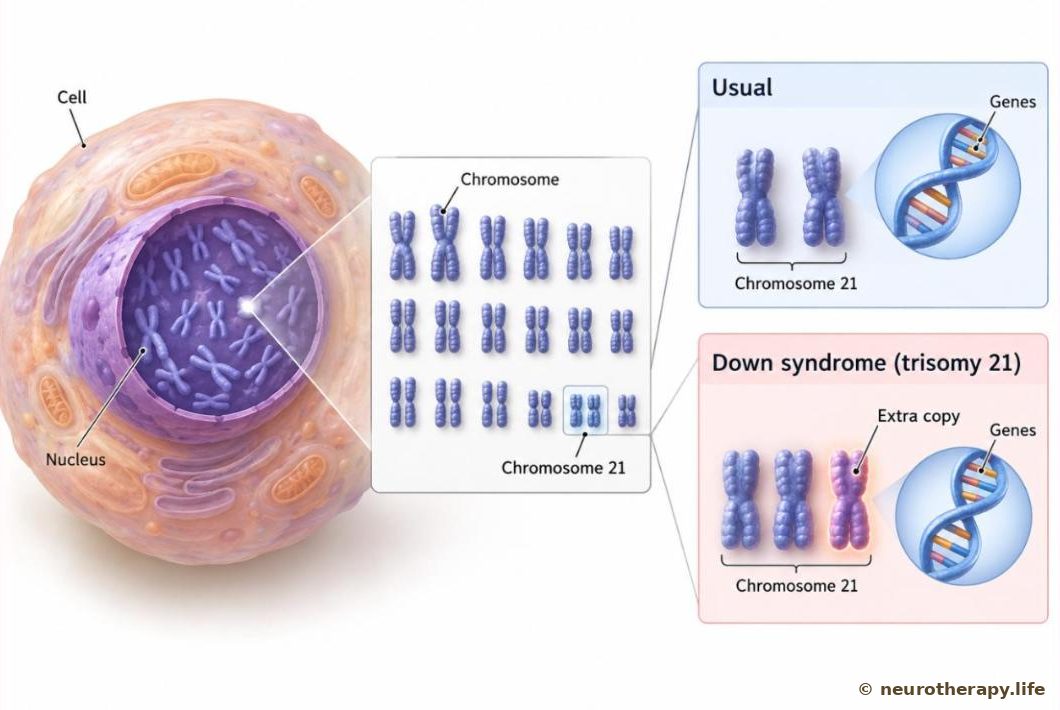
- About 1 in 700 babies is born with Down syndrome
- About 95% of cases are trisomy 21 — a full extra chromosome 21 in every cell
- It is the most common chromosome-related condition; many people now live into their 60s or longer
Source: MedlinePlus; Cleveland Clinic
What is Down syndrome?
Our genes are packed into chromosomes — usually 23 pairs in each cell. In Down syndrome there is an extra copy of all or part of chromosome 21. It happens by chance as cells divide, and it is usually not passed down from the parents. The extra genetic material affects how the body and the brain grow.
There are three types. Trisomy 21 (about 95%) has the extra chromosome in every cell. In translocation (about 3%) an extra part is attached to another chromosome. In mosaic Down syndrome (about 2%) only some cells have it. Many children have soft, floppy muscles, loose joints and late milestones, and some are born with a heart defect.
What are the symptoms?
- A flat face, eyes that slant upward, a short neck, and small hands and feet
- Soft, floppy muscles and loose joints
- Late milestones and mild to moderate learning difficulty
- Hearing loss, ear infections and eye problems
- A heart defect present from birth in some babies
- Thyroid problems, digestive problems and sleep apnoea (breathing pauses in sleep)
What causes it, and who is more likely to get it?
The extra chromosome
- Trisomy 21: an extra chromosome 21 in every cell, by chance as cells divide
- Translocation: an extra piece of chromosome 21 attached to another chromosome
- Mosaic: the extra chromosome in only some cells
What raises the chance
- The mother's age — women aged 35 and older are more likely to have a baby with Down syndrome
- In most families it is not inherited
How is it found?
Down syndrome can be looked for before birth and confirmed after birth. Screening tests only show the chance; diagnostic tests give a definite answer.
Screening in pregnancy
Blood tests, an ultrasound measure of the fluid at the back of the baby's neck, and cell-free DNA tests (NIPT) estimate the chance.
Diagnostic tests in pregnancy
Amniocentesis or chorionic villus sampling look at the baby's chromosomes directly.
Karyotype after birth
A blood test that counts and pictures the chromosomes; a faster FISH test may come first.
Health checks
Heart, hearing, eyes, thyroid and sleep are checked regularly, because problems there are more common.
A neurotherapist asks for the doctor's reports — especially the heart, thyroid and any neck (spine) check — and the therapy plan. The therapist asks the child's age and whether there has ever been cancer, because these decide whether WD may be given. Small children cannot point to their pain, so the therapist watches the face and breath and asks the parents about stools, appetite and sleep.
How Neurotherapy sees Down syndrome
LMNT teaching does not claim to change the chromosome. Its own account says many children with Down syndrome came for treatment, and since the pain points of small children cannot be found, treatment to correct the stomach was given first — and helped. Then came the thought that a trouble present from birth may be linked with the organs of generation, which LMNT reaches through the WD point. So the Pan–WD formula, later named New Genes, was given, and a clear difference was reported within days. Parents report substantial improvement in quality of life.
How LMNT teaching reads a child with Down syndrome
- No pain to point toSmall children cannot show where it hurts
- Stomach firstTreatment to correct the stomach comes first
- Present from birthRead in LMNT as linked with the organs of generation — the WD point
- New Genes(8) Pan (6) WD (8) Ch. Only (20) Round arrow — light, for a child
- Watch daily lifeEating, sitting, sleeping, holding — not a percentage, not a promise
In the New Genes formula, (8) Pan and (6) WD work below and above the navel; (8) Ch. Only and the Round arrow down the spine follow to keep the acid–alkali balance. LMNT teaching also gives this formula for club foot and cerebral palsy — other troubles present from birth.
Every person, from a one-day-old infant up to the age of a hundred years, can take this treatment.
Neurotherapy treatment for Down syndrome, step by step
Examine first — gently
The therapist reads the heart, thyroid and neck reports, asks the parents about stools, appetite and sleep, and watches the child's face and breath rather than waiting for words.
Check the bars
WD, at the heart of New Genes, is not given in cancer and not in the teenage years. If either applies, the therapist changes the plan.
Stomach first
In LMNT's own account, treatment to correct the stomach was given first to these children, and it helped.
New Genes, light and by hand
(8) Pan (6) WD (8) Ch. Only (20) Round arrow — for a child, with the hands, light pressure and half the adult dose, a parent present.
Record real gains
Progress is written as what the child can now do — eating, sitting, sleeping, holding, speaking — that they could not do a fortnight ago.
Points and formulas used
New Genes formula
Genes formula No. 3, once called the Pan–WD formula — given in LMNT for Down syndrome, club foot, cerebral palsy and other troubles present from birth.
Works through
Open →Never do this
- WD — the heart of the New Genes formula — is never given in cancer, and not in the teenage years. The therapist changes the plan. WD
- Some people with Down syndrome have a loose joint at the top of the neck. The head and neck are always handled gently. See a doctor at once for a change in walking or hand use, a change in bladder or bowel control, neck pain or stiffness, a head that stays tilted, or new weakness.
- Breathlessness, blue lips, fainting or poor feeding in a baby with a heart defect needs a doctor or hospital first. Heart disorders
- Down syndrome is lifelong. Neurotherapy does not change the chromosome; it may support comfort and daily ability, with reported improvement. Keep the doctor, physiotherapy, speech therapy, early intervention and school going — never in place of them.
- Children get half the adult dose and light treatment only, given by a trained therapist.
- Cancer: if the person has cancer, (10) Pan, Thymus, Pit, Lu + Sh, Rt. Ov / Lt. Ov and (30) Medulla are never given — the therapist changes the plan.
- Keep taking the medicines your doctor prescribed. Neurotherapy works alongside your medical care, never instead of it.
Watch
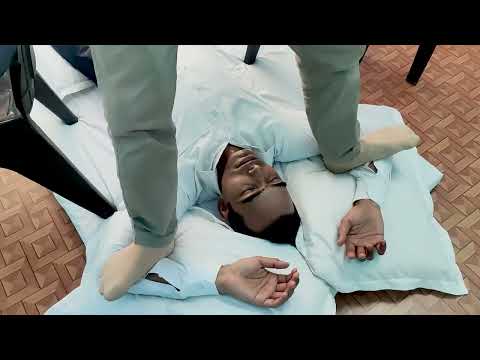
A step-by-step demonstration, in Hindi, of the New Genes formula: (8) Pan at the thigh–hip crease, (6) WD on both forearms, (8) Ch. Only and the Round Arrow, with the patient's position and how each count is kept.
A step-by-step demonstration of the New Genes formula on an adult. For a child, the same formula is given with the hands, light pressure and half the dose.
From Ayurveda and the kitchen
Test yourself
What research says
- Strong evidence
This expert overview explains how the extra chromosome 21 — carrying more than 200 protein-making genes — changes the body and brain in many systems at once, and why each person is affected differently.
Antonarakis SE, Skotko BG, Rafii MS, et al. Down syndrome. Nat Rev Dis Primers. 2020.
No clinical trial of Neurotherapy in Down syndrome has been published yet. Improvements reported by neurotherapists and parents are clinical observations.
For you
Parents of a baby
Get the heart, hearing, eyes and thyroid checked as your doctor advises, and start early therapy. Bring every report to each Neurotherapy visit and stay in the room.
Families expecting a baby
Screening tests in pregnancy show the chance; only diagnostic tests give a definite answer. Talk them through with your doctor.
Teenagers and adults
Keep up regular health checks and stay active. Tell the therapist your age — WD is not given in the teenage years.
This page explains; it does not diagnose. Neurotherapy works alongside your medical care — keep taking the medicines your doctor prescribed, and see a doctor for any new or severe symptom.