Double vision (diplopia)
Double vision means seeing two images of one thing. It can come from the eye itself, or from the small muscles and nerves that aim the two eyes together. Double vision that starts suddenly can be a sign of a stroke and needs a doctor at once.
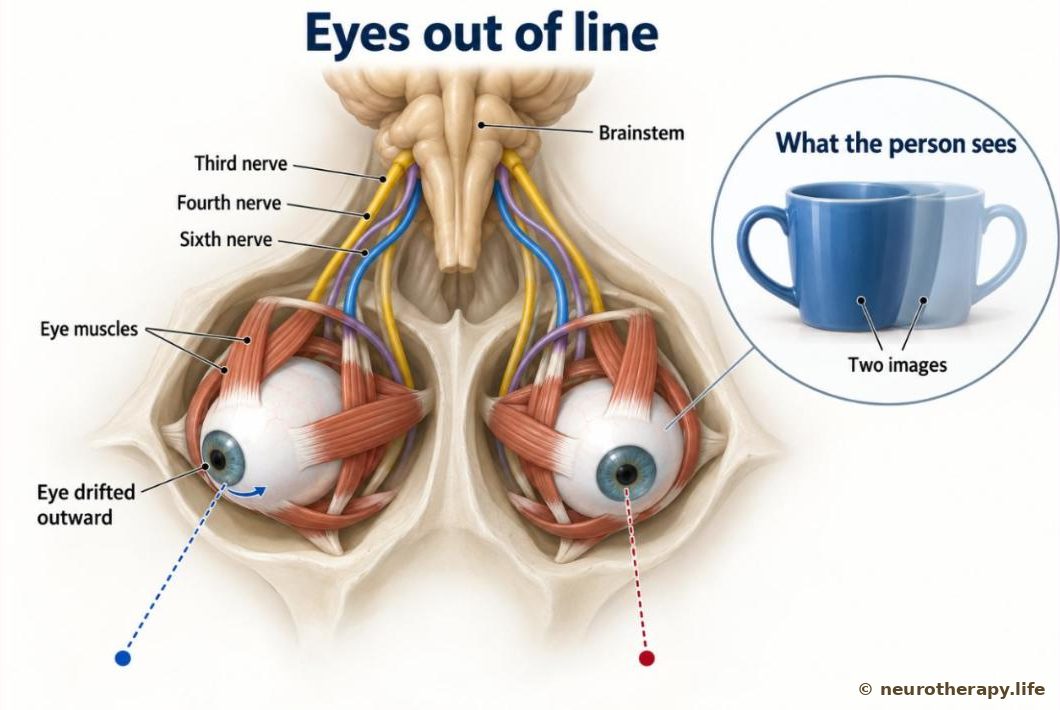
- Six small muscles move each eye, and three nerves run them
- Cover one eye: if the double image goes, the eyes are out of line
- About 800,000 Americans see an eye specialist for double vision each year
Source: Cleveland Clinic; NHS; StatPearls
What is Double vision (diplopia)?
Normally both eyes point at exactly the same spot, and the brain joins their two pictures into one. If one eye drifts even slightly, the brain gets two pictures that do not match — and you see double. This kind, which goes away when you cover either eye, is called binocular double vision.
If the double image stays even with one eye covered, the problem is inside that eye — such as dry eye, a cataract or an uneven cornea. This one-eye kind is more common and usually less serious. The both-eyes kind can come from the eye muscles, their nerves, or the brain.
What are the symptoms?
- Seeing two images of one object, side by side or one above the other
- Double vision that is worse when looking in one direction
- Closing one eye or tilting the head to see clearly
- Headache, dizziness or nausea
- Eye pain when moving the eyes, or a drooping eyelid
What causes it, and who is more likely to get it?
Eye muscles and their nerves
- Weakness of the third, fourth or sixth nerve
- Squint
- Myasthenia gravis
- Thyroid eye disease
Whole-body conditions
Brain and injury
- Stroke or a mini-stroke
- Head or eye injury
- A swelling of a blood vessel (aneurysm) or a growth in the head
How is it found?
The first question is simple: does the double image go away when you cover one eye? The answer tells the doctor where to look.
Cover test
Each eye is covered in turn, to tell one-eye double vision from both-eyes double vision.
Vision and eye movement check
Reading a chart, and following a moving finger, to see which muscle or nerve is weak.
MRI or CT scan
Pictures of the brain and eye sockets, usually needed when both eyes are involved.
Blood tests
To look for causes such as diabetes or thyroid disease.
A neurotherapist first asks when it started. Sudden double vision goes to a hospital, not to a mat. For long-standing double vision already checked by a doctor, the therapist looks at where the eye is sitting — because that finding, not the word 'double', chooses the treatment.
How Neurotherapy sees Double vision (diplopia)
LMNT teaching works on the nerves of the head through the Medulla, at the top of the neck, using a different number for each nerve. For double vision the patient's complaint is the same word every time — but the finding is different, and the finding chooses the number.
Where the eye sits chooses the number
- First: (15) MedullaGiven before any Medulla treatment for a nerve of the head
- Pupil dilated — (3) MedullaThe third nerve, which runs most of the eye muscles, the upper lid and the pupil
- Eye resting down and outward — (4) MedullaThe fourth nerve and the muscle that turns the eye down and out
- Pupil crooked up and outward — (6) MedullaThe sixth nerve and the muscle that turns the eye outward
- Three times, with restsEach is given three times, one and a half minutes apart
Three rows for double vision, three different numbers — that is not a contradiction but a way of examining. LMNT teaching also says honestly that some of these numbers are still being studied, and asks the therapist to write down what they see.
Neurotherapy treats according to the condition of the body.
Neurotherapy treatment for Double vision (diplopia), step by step
Examine first
The therapist asks when the double vision began and what the doctor found, checks Liv° and Mu°, and watches the eyes to see where each one is sitting.
(15) Medulla first
Given at the top of the neck before any Medulla number for a nerve of the head. The thumb slides and presses; the head is never twisted or jerked.
Choose the number by the finding
(3) Medulla where the pupil is dilated; (6) Medulla where the pupil is crooked up and outward; (4) Medulla where the eye rests down and outward.
Three times, then watch
Each is given three times, one and a half minutes apart. If dizziness or new double vision appears during treatment, tell the therapist at once — they stop.
Points and formulas used
Medulla, the graded series
One place on the neck, a different number for each nerve of the head — (3), (4) and (6) are the ones named for double vision, always after (15).
Works through
Open →Never do this
- Emergency first: double vision that starts suddenly, or comes with a severe headache, a widened pupil, dizziness or unsteadiness, slurred speech, a drooping face or weakness in an arm, or after a head injury — call 108/112. No pressure is put on the neck.
- Facial pain with fever, swelling around the eye, a bulging eye or any change in vision — no face treatment; see a doctor the same day. Sinus Point
- (6) Medulla is not given to 13–20-year-olds who are being treated for height, unless there is a special need. (6) Medulla
- Do not drive while you see double, until a doctor says it is safe.
- Cancer: if the person has cancer, (10) Pan, Thymus, Pit, Lu + Sh, Rt. Ov / Lt. Ov and (30) Medulla are never given — the therapist changes the plan.
- Keep taking the medicines your doctor prescribed, and keep your eye specialist's follow-up. Neurotherapy works alongside your medical care, never instead of it.
From Ayurveda and the kitchen
Test yourself
What research says
- Strong evidence
The six eye muscles are run by cranial nerves III, IV and VI, whose centres lie in the brainstem. Double vision that disappears when either eye is covered comes from misaligned eyes and may need urgent scans; double vision in one eye usually comes from the eye's optics.
No clinical trial of Neurotherapy for double vision has been published yet. Improvements reported by neurotherapists are clinical observations.
For you
People with diabetes or high blood pressure
Keep sugar and blood pressure under good watch, and get new double vision checked the same day.
Older adults
Cataract and dry eye are common causes of double vision in one eye. An eye check can sort it out.
Children
A squint in a child needs an eye specialist early. Children get half the adult dose and light treatment only, given by a trained therapist.
This page explains; it does not diagnose. Neurotherapy works alongside your medical care — keep taking the medicines your doctor prescribed, and see a doctor for any new or severe symptom.