Cough (and Bronchitis)
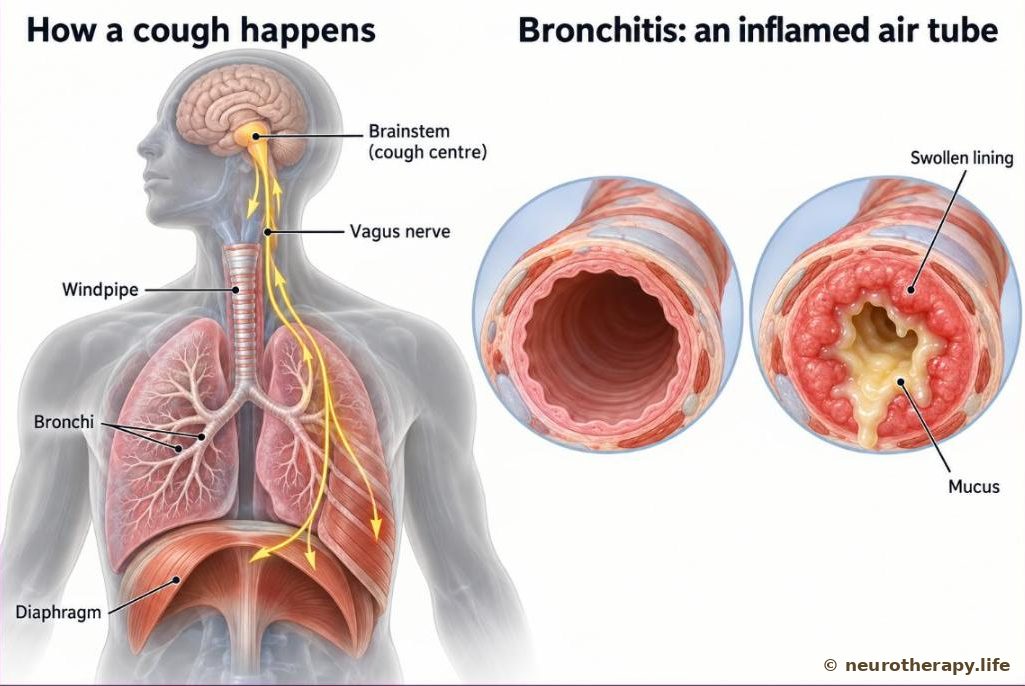
A cough is the body's reflex for clearing the throat and airways. Most coughs come with a cold or flu and settle within 3 to 4 weeks. Bronchitis is swelling of the air tubes in the lungs, with cough and phlegm. A cough that lasts longer, or brings up blood, needs a doctor.
- Most coughs clear up by themselves within 3 to 4 weeks
- A cough lasting more than 3 weeks should be checked by a doctor
- A cough is called chronic when it lasts 8 weeks or more in adults, or 4 weeks in children
Source: NHS; Mayo Clinic; MedlinePlus
What is Cough (and Bronchitis)?
Coughing is a reflex that keeps your throat and airways clear. When dust, smoke, mucus or germs touch sensors in the lining of your airways, a signal travels up a nerve to a cough centre in the brainstem. The brainstem answers by squeezing your chest muscles hard, and a burst of air pushes the irritant out.
A short cough that starts suddenly usually comes with a cold, flu or bronchitis and goes away on its own. In bronchitis, the air tubes of the lungs swell and make extra mucus, so the cough brings up phlegm. A cough that keeps going for many weeks has a cause that needs to be found.
What are the symptoms?
- Dry, tickly cough with nothing coming up
- Cough with phlegm — clear, white, yellow or green
- Sore throat or a hoarse voice from coughing
- A feeling of mucus dripping down the back of the throat, or a runny nose
- Wheezing or shortness of breath, as can happen with bronchitis or asthma
- Cough that disturbs sleep and leaves you tired
What causes it, and who is more likely to get it?
Infections
Airways and allergy
- Asthma
- Allergies such as hay fever, and mucus dripping from the back of the nose
Smoke and irritants
- Smoking — the most common cause of a long-lasting cough
- Dust, fumes and air pollution
Other causes
- Acid coming up from the stomach (reflux)
- Some medicines, including some blood-pressure tablets
- Long-term lung diseases such as COPD, and rarely lung cancer
How is it found?
A short cough with a cold usually needs no tests. A cough that lasts for weeks, brings up blood or comes with fever or breathlessness is checked with an examination and tests.
Chest X-ray
A picture of the lungs to look for pneumonia, TB or other lung disease.
Sputum test
The phlegm you cough up is tested for germs, including TB.
Lung function tests
You blow into a tube to measure how well air moves in and out — this helps find asthma or COPD.
Bronchoscopy
For a few people only: a thin tube with a camera looks inside the airways.
A neurotherapist listens to the kind of cough — dry or wet, the colour of the phlegm, when it comes — and checks Liv° and Mu°. They also ask about asthma, blood pressure and the heart, because each changes which points may be given. A cough for more than 3 weeks, blood in the phlegm or weight loss goes to a doctor first, for a TB test.
How Neurotherapy sees Cough (and Bronchitis)
In LMNT teaching, (5) Medulla has proved useful for almost every kind of cough. Guruji's teaching describes nine kinds of cough that a therapist learns to tell apart just by listening, with no instrument at all — the dry cough, the very forceful cough, the cough of asthma, the bronchial cough that comes on turning in bed or getting up, with grey, frothy phlegm, the scraping, metallic cough of laryngitis, the hard, painful cough of the lungs, and the whooping cough in which the face turns red. For each of them the point written is (5) Medulla.
How a cough happens
- Irritationmucus, dust or germs touch the airway lining
- Sensorsnerve endings in the lining fire a signal
- Vagus nervecarries the signal up to the brainstem
- Cough centrein the medulla, it orders the cough
- Breathing musclessqueeze hard, and air bursts out
For bronchitis, LMNT teaching gives (6) Right Swt where breathing out is difficult, with Stretch and (10) Medulla — (10) Medulla acts on the smooth muscle of the windpipe and the air tubes. Guruji also left an honest note beside the cough teaching: in the detailed knowledge of what (6) Medulla and (10) Medulla do, some further discovery remains to be made.
We do not give treatment for any one disease; rather we treat according to the condition of the body on that day.
Neurotherapy treatment for Cough (and Bronchitis), step by step
Examine first
The therapist checks Liv° and Mu°, listens to the cough and asks about the phlegm, how long it has lasted, and about asthma, blood pressure and the heart.
(5) Medulla for the cough
(5) Medulla is the point LMNT teaching gives for almost every kind of cough — dry or wet, forceful, bronchial or the cough of asthma.
Throat and catarrh
(4) Thrd is listed for cough, cold, catarrh and throat problems, and Sangam points are also named for cough. (4) Thrd is never given in asthma, and in heart patients (2) Thrd is given instead.
When it is bronchitis
(6) Right Swt is given for difficulty in breathing out, with Stretch and (10) Medulla. (6) Right Swt is not given if the blood pressure is high.
Points and formulas used
(6) Right Swt
For bronchitis with difficulty in breathing out. Not for people with high blood pressure.
Open →Never do this
- (4) Thrd is not given in asthma — the cough increases. In heart patients (2) Thrd is given in its place. (4) Thrd
- (6) Right Swt is not given to people with high blood pressure. (6) Right Swt
- Thrd is given with the flat of the palm, a light push released at once — never a fingertip, never a hold. The patient is told beforehand that a cough may come during it. No pressure ever falls on the front of the neck. Thrd
- See a doctor first: coughing up blood, breathlessness, chest pain, a high fever, a barking or whooping cough, or a cough with weight loss. A cough that lasts more than 3 weeks needs a doctor and a TB test. Severe difficulty breathing or a lot of blood is an emergency — call 108/112.
- Cancer: if the person has cancer, (10) Pan, Thymus, Pit, Lu + Sh, Rt. Ov / Lt. Ov and (30) Medulla are never given — the therapist changes the plan.
- Keep taking the medicines your doctor prescribed. Neurotherapy works alongside your medical care, never instead of it.
From Ayurveda and the kitchen
Test yourself
What research says
- Strong evidence
This review explains the path of a cough: signals from sensors in the airways travel mainly along the vagus nerve to a cough centre in the brainstem (the medulla), which then drives the breathing muscles. The medulla is the region LMNT's Medulla points are named after.
No clinical trial of Neurotherapy for cough or bronchitis has been published yet. Improvements reported by neurotherapists are clinical observations.
For you
Children
A barking or whooping cough, vomiting after coughing, or fever for more than a day or two needs a doctor. Do not give cough medicine to a child under four.
Smokers
Smoking is the most common cause of a long-lasting cough. A cough that changes, or brings up blood, needs a doctor's check.
People with asthma, heart disease or high blood pressure
Tell your therapist — (4) Thrd is not given in asthma, (2) Thrd replaces it in heart patients, and (6) Right Swt is not given with high blood pressure.
This page explains; it does not diagnose. Neurotherapy works alongside your medical care — keep taking the medicines your doctor prescribed, and see a doctor for any new or severe symptom.