Club foot (talipes)
Club foot is a problem present from birth: one or both feet are turned inward and downward and cannot easily be moved into the normal position. With early treatment by an orthopaedic doctor — gentle stretching, weekly plaster casts and then a brace — most children grow up to walk normally.
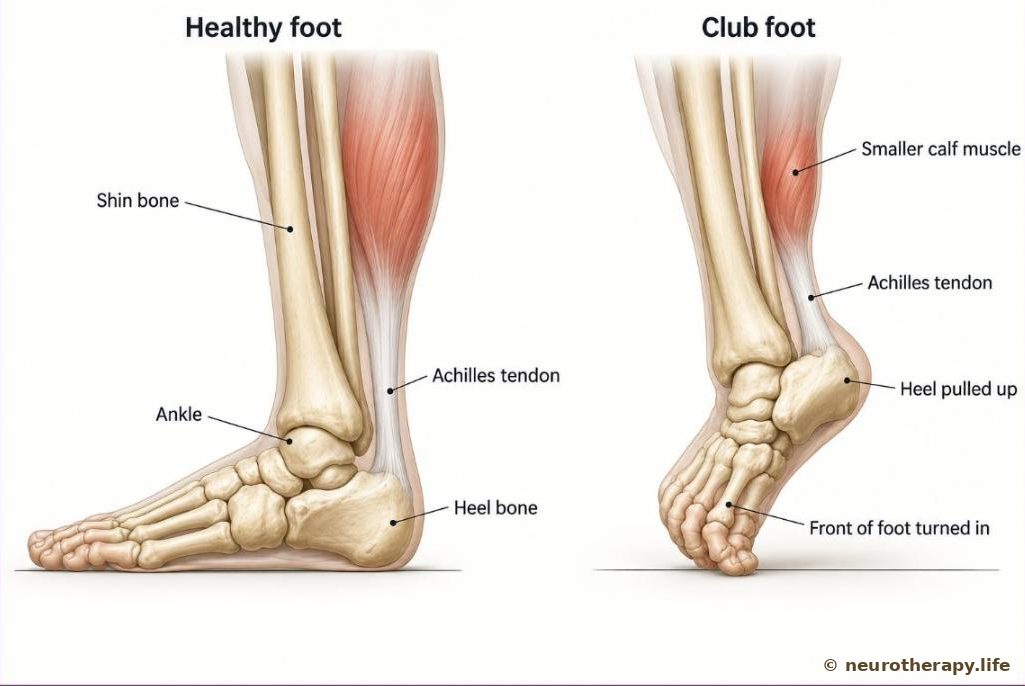
- About 1 in every 1,000 babies is born with club foot
- Boys are about twice as likely to have it as girls
- In about half of the children, both feet are affected
- Most children need about 5 to 10 plaster casts to straighten the foot
Source: Mayo Clinic; MedlinePlus; NHS
What is Club foot (talipes)?
In club foot, the bones, joints, muscles and tendons of the foot and lower leg have formed in a twisted position in the womb. The foot points inward and down, the heel is pulled up, and the calf on that side is often smaller. It is not painful for a baby, but without treatment the child walks on the side or top of the foot.
The usual treatment starts within the first weeks of life. The doctor gently stretches the foot a little each week and holds it in a new plaster cast. Many babies then need a tiny procedure to loosen the tight heel cord, and afterwards wear special boots joined by a bar — full-time for about three months, then at night for several years. If the brace is not worn, the foot can turn back.
What are the symptoms?
- At birth, the foot points inward and downward
- The foot feels stiff and tight and will not move easily into a normal position
- The heel is turned in and pulled up; in severe cases the foot looks upside down
- The calf muscle on that side is smaller, and the foot may be slightly shorter
- When walking begins without treatment, the child walks on the ball, side or top of the foot, with the heel off the ground
What causes it, and who is more likely to get it?
Family and genes
- The exact cause is usually unknown
- A parent, brother or sister with club foot
- Being a boy
During pregnancy
- Smoking by the mother during pregnancy
- Too little fluid around the baby in the womb
How is it found?
Club foot is usually seen at birth, and sometimes on a pregnancy scan. A foot that only looks bent because of the baby's position in the womb (positional club foot) moves easily and corrects on its own; a true club foot is stiff.
Pregnancy ultrasound
A scan in the first six months of pregnancy can sometimes show the turned foot, so the family can plan early care.
Examination at birth
The doctor looks at the shape of the foot and gently tries to move it, to tell a stiff club foot from a positional one.
Orthopaedic check and X-ray
A children's bone specialist should see the baby within a few weeks of birth; an X-ray or ultrasound of the foot is sometimes done.
A neurotherapist first makes sure the child is under an orthopaedic doctor, and asks what stage of casting or bracing the child is in. The therapist asks the mother how the child stands, walks and balances — and asks her what she feels in her own hands when she holds the child up to walk.
How Neurotherapy (LMNT) sees Club foot (talipes)
In LMNT, club foot is given the New Genes formula, with the WD point within it. Guruji's reasoning was that a trouble present from birth is perhaps connected with the organs of generation — and in this therapy the WD point, just below the navel, is the one used for them. The word 'perhaps' is Guruji's own: this is his thinking, offered for research, not a settled fact.
How LMNT teaching reasons about club foot
- Present from birthThe foot was turned before the child was born
- Perhaps the genesLMNT links troubles present from birth with the organs of generation
- WDThe point just below the navel, used for those organs
- New Genes formulaPan and WD, then Ch. Only and the Round Arrow to keep acid and alkali in balance
- Watch and measureHow far the heel is from the ground, balance, and the weight on the mother's hand
LMNT teaching is plain that the time scale is long — months, and even years — and that this should be said to the family on the first day. Today, every child with club foot should begin orthopaedic treatment early; Neurotherapy (LMNT) is given alongside the casting and the brace, never in place of them.
Every person, from a one-day-old infant up to the age of a hundred years, can take this treatment.
Neurotherapy (LMNT) treatment for Club foot (talipes), step by step
Orthopaedic care first
The therapist checks that the child is under a children's orthopaedic doctor and asks where the child is in the casting or bracing. Neurotherapy (LMNT) never replaces a cast or a brace.
Examine and ask the mother
The therapist measures how far the heel stays above the ground, watches the child's balance, and asks the mother how much of the child's weight comes on her hand when she helps the child walk.
The New Genes formula
(8) Pan, (6) WD, (8) Ch. Only and the Round Arrow. For a small child it is given with the hands, with light pressure and half the adult dose.
Record the change in numbers
Progress is written down in inches and months — the height of the heel, the balance, the mother's effort — so that it can be checked, and it is shared with the child's doctor.
Points and formulas used
New Genes formula
Genes formula No. 3, once called the Pan–WD formula — given in LMNT for club foot, Down syndrome, cerebral palsy and other troubles present from birth.
Works through
Open →Never do this
- WD — the heart of the New Genes formula — is never given in cancer, and not in the teenage years. The therapist changes the plan. WD
- Club foot needs early orthopaedic care — stretching, weekly casts and then a brace. Neurotherapy (LMNT) is given only alongside it, never in place of it. Stopping the brace early is the most common reason the foot turns back.
- Call the doctor at once if the toes under a cast swell, bleed or change colour, if the cast causes a lot of pain, if the toes slip back into the cast or the cast becomes loose, or if the foot starts turning inward again.
- Children get half the adult dose and light treatment only, given by a trained therapist.
- Cancer: if the person has cancer, (10) Pan, Thymus, Pit, Lu + Sh, Rt. Ov / Lt. Ov and (30) Medulla are never given — the therapist changes the plan.
- Keep taking the medicines your doctor prescribed. Neurotherapy (LMNT) works alongside your medical care, never instead of it.
Watch
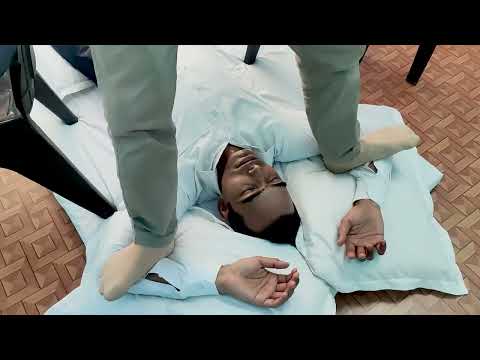
A step-by-step demonstration, in Hindi, of the New Genes formula: (8) Pan at the thigh–hip crease, (6) WD on both forearms, (8) Ch. Only and the Round Arrow, with the patient's position and how each count is kept.
A step-by-step demonstration of the New Genes formula on an adult. For a child with club foot, the same formula is given with the hands, light pressure and half the dose — alongside the orthopaedic casting and brace.
From practice
The child whose heel would not come down
Recorded in the therapy's own account — a case from Guruji's teaching; the child's name was not recorded
A small child, brought by his mother · the foot turned inward from birth
- What was found
- The child walked only on the ball of the foot. When the mother held him up to walk, his heel stayed three to four inches above the ground, and a lot of his weight came on her hand.
- What was done
- The New Genes formula was given. After the first treatment, the mother said less of the child's weight was coming on her hand. After three or four days, the heel came at times to within one and a half or two inches of the ground. Over the following months his balance improved a good deal, and after eight to nine months the front of the foot was becoming much straighter.
- What it teaches
- The first change was noticed by the mother's hand, not seen in the foot — the person who lifts a child every day is a measuring instrument no one else has. The case is told in inches and months, so it can be checked, and the time scale is long: tell the family so on day one. One child's story is not proof, and it is no reason to delay casting.
From Ayurveda and the kitchen
Test yourself
What research says
- Strong evidence
This review of 12 studies, covering 852 children, found the Ponseti method — gentle stretching, a series of casts and then a brace — very effective in straightening club foot. The foot turned back in 2% to 27% of children, most often because the brace was not worn as advised.
No clinical trial of Neurotherapy (LMNT) in club foot has been published yet. Improvements reported by neurotherapists are clinical observations.
For you
Parents of a newborn
If your baby's foot is turned in and stiff, ask for a children's orthopaedic doctor within the first few weeks. Early casting works best.
Parents during bracing
Keep the boots and bar on for as long as the doctor asks — full-time at first, then at night for years. Tell the therapist and the doctor about any change you feel in the child's walking or balance.
During pregnancy
Avoid smoking and second-hand smoke, and keep up regular check-ups and scans.
This page explains; it does not diagnose. Neurotherapy (LMNT) works alongside your medical care — keep taking the medicines your doctor prescribed, and see a doctor for any new or severe symptom.