Cataract
A cataract is a clouding of the clear lens inside the eye. Sight slowly becomes blurred, faded and glary. When it gets in the way of daily life, surgery to replace the lens is the only proven fix.
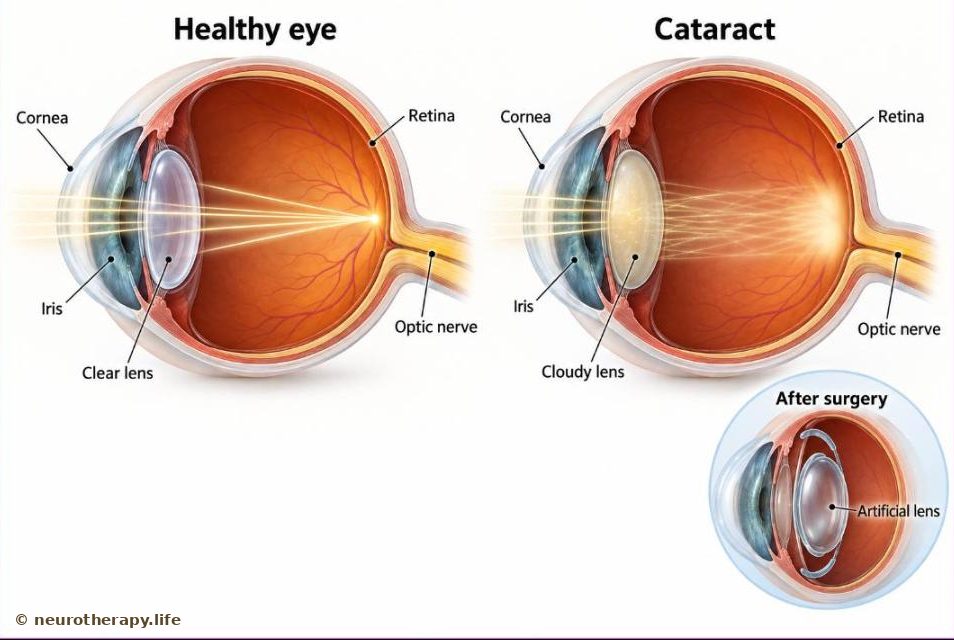
- Cataract causes vision loss or blindness in about 94 million people worldwide
- By age 80, more than half of Americans have a cataract or have had it operated
- 9 out of 10 people see better after cataract surgery
Source: World Health Organization (Blindness and vision impairment fact sheet); MedlinePlus (Cataract); National Eye Institute (NIH)
What is Cataract?
Behind the coloured part of your eye sits the lens. It is clear, like glass, and it focuses light on the retina — the seeing layer at the back of the eye. The lens is made mostly of water and protein.
With age, some of this protein breaks down and clumps together. The clumps make a cloudy patch that slowly grows, so less clear light reaches the retina. A cataract can come in one eye or both, but it does not spread from one eye to the other.
What are the symptoms?
- Cloudy, blurry or misty vision
- Colours that look faded or yellowish
- Glare — lights seem too bright or have halos around them
- Poor vision at night
- Double vision in one eye
- Needing new glasses often
What causes it, and who is more likely to get it?
Age
- Getting older — the most common cause by far
- Family history of cataract
Health conditions
- Diabetes
- An eye injury or earlier eye surgery
Habits and surroundings
- Smoking
- Heavy alcohol use
- Many hours of strong sun on the eyes
Medicines and treatments
- Long-term steroid medicines
- Radiation treatment to the upper body
How is it found?
Early cataracts may cause no trouble at all, so they are usually found at an eye check-up.
Dilated eye exam
Drops widen the pupils so the eye doctor can look at the lens and the back of the eye. It is painless; sight may be blurry for a few hours afterwards.
Regular check-ups after 60
The US National Eye Institute advises a dilated eye exam every 1 to 2 years from age 60 — it also finds silent problems such as glaucoma.
A neurotherapist asks for the eye doctor's report before the first session: how far the cataract has gone, and whether surgery has been advised. If it has, the advice is simple — have the operation. Diabetes, heart disease, kidney disease and cancer are asked about too, because each one changes which points may be given.
How Neurotherapy (LMNT) sees Cataract
Neurotherapy (LMNT) does not remove a cataract, and LMNT does not claim to. Guruji's teaching looks at the body behind the eye — the pancreas, digestion and the glands. (10) Pan and (18) Pan are named in LMNT as excellent for cataract and eye diseases, and T8 is given for cataract and weakness of the eyes. Two formulas built for digestion and the glands, Formula No. 4 and the Chole treatment, also list cataract among their uses.
Guruji recorded honestly that not every eye patient has had the same benefit. LMNT teaching adds the line every therapist owes the patient: a cataract is treated by an operation that works. A patient who puts off that operation because a treatment seems to be helping has been harmed — even if the treatment itself did nothing wrong. Neurotherapy (LMNT) may support general eye comfort and the body's digestion alongside the eye doctor's care; it never replaces or delays surgery.
Whether or not the patient gets immediate benefit from our treatment, let no harm reach him through our carelessness — attend to this.
Neurotherapy (LMNT) treatment for Cataract, step by step
Examine first
The therapist checks the diagnostic points Liv° and Mu°, reads the eye doctor's report, and asks about diabetes, heart, kidney disease and cancer. If surgery has been advised, you are told to go ahead with it.
The Pan points
(10) Pan, which LMNT links with insulin, and (18) Pan — both named in Guruji's teaching for cataract and eye diseases.
T8 — comfortably
Given for cataract and weakness of the eyes, until the tenderness at the point goes — but always comfortably, never so hard that the pain increases.
Digestion and the glands
Where the examination calls for it, Formula No. 4 or the Chole treatment is chosen. Chole is given after a preparatory treatment for the gall bladder and liver.
Surgery when your eye doctor advises it
When the cataract gets in the way of reading, driving or daily work, surgery is the answer. Neurotherapy (LMNT) can continue alongside, never in its place.
Points and formulas used
Formula No. 4
Built for severe pain at Pan that has outlasted other treatments; it works on the vagus nerve, the pituitary and the spinal nerves, and LMNT lists cataract and other eye diseases among its uses.
Open →Chole Treatment
Supports the digestion of fats through the gut hormones and the gall bladder; LMNT also names it for cataract and night blindness.
Works through
Open →Never do this
- A cataract that blocks your sight is fixed only by surgery. Neurotherapy (LMNT) never replaces it and must never delay it — if your eye doctor advises the operation, have it. Eyes
- Eye emergency — go to an eye hospital the same day: sudden loss of vision, severe eye pain, a painful red eye that cannot bear light, an injury to the eye, or chemicals in the eye. Also: loss of vision with giddiness, or new trouble seeing with the worst headache of your life.
- T8 is given only until the tenderness goes, and comfortably — never so hard that the pain increases. T8
- Formula No. 4 and the Chole treatment begin with (10) Medulla: in heart disease only (10) Left Medulla is given, and it is left out for a diabetic person who does not feel well with it. The Chole treatment is not given in kidney failure. (10) Medulla
- Pan points are not given in fits (epilepsy) or schizophrenia, except inside a Heparin formula. Pan
- Cancer: if the person has cancer, (10) Pan, Thymus, Pit, Lu + Sh, Rt. Ov / Lt. Ov and (30) Medulla are never given — the therapist changes the plan.
- Keep taking the medicines your doctor prescribed. Neurotherapy (LMNT) works alongside your medical care, never instead of it.
Watch

A demo of the Chole treatment ((10) Medulla, (6) Gas 'I', (3) Gal), shared for acidity, heavy meals and the digestion of fats.
The Chole treatment — one of the formulas LMNT names for cataract. The video shows it for digestion.
Test yourself
What research says
- Strong evidence
A major review: cataract is still the leading cause of blindness in developing countries, and modern small-incision surgery gives good results and can also correct the need for glasses.
Liu YC, Wilkins M, Kim T, Malyugin B, Mehta JS. Cataracts. Lancet. 2017.
No clinical trial of Neurotherapy (LMNT) in cataract has been published yet. Improvements reported by neurotherapists are clinical observations.
For you
People over 60
Have a dilated eye exam every 1 to 2 years, even if you see well. Wear sunglasses and a hat in strong sun.
People with diabetes
Diabetes raises the risk of cataract and of other eye problems. Keep your regular eye check-ups and tell your therapist you have diabetes.
People waiting for surgery
Brighter lamps and updated glasses can help for a while. Keep your surgery date — do not put it off.
This page explains; it does not diagnose. Neurotherapy (LMNT) works alongside your medical care — keep taking the medicines your doctor prescribed, and see a doctor for any new or severe symptom.