Toothache (tooth, gum and jaw pain)
Toothache is pain in or around a tooth. It is a warning sign with a cause — most often decay, an infection or a cracked tooth — and it needs a dentist. A tight, clenching jaw muscle can also feel exactly like toothache.
- See a dentist if a toothache lasts more than 2 days
- Toothache with a fever over 38.3 °C (101 °F), or a swollen face or jaw, needs care urgently
- The upper and the lower teeth get their feeling from two different branches of the same large face nerve
Source: NHS; Cleveland Clinic; MedlinePlus; StatPearls
What is Toothache (tooth, gum and jaw pain)?
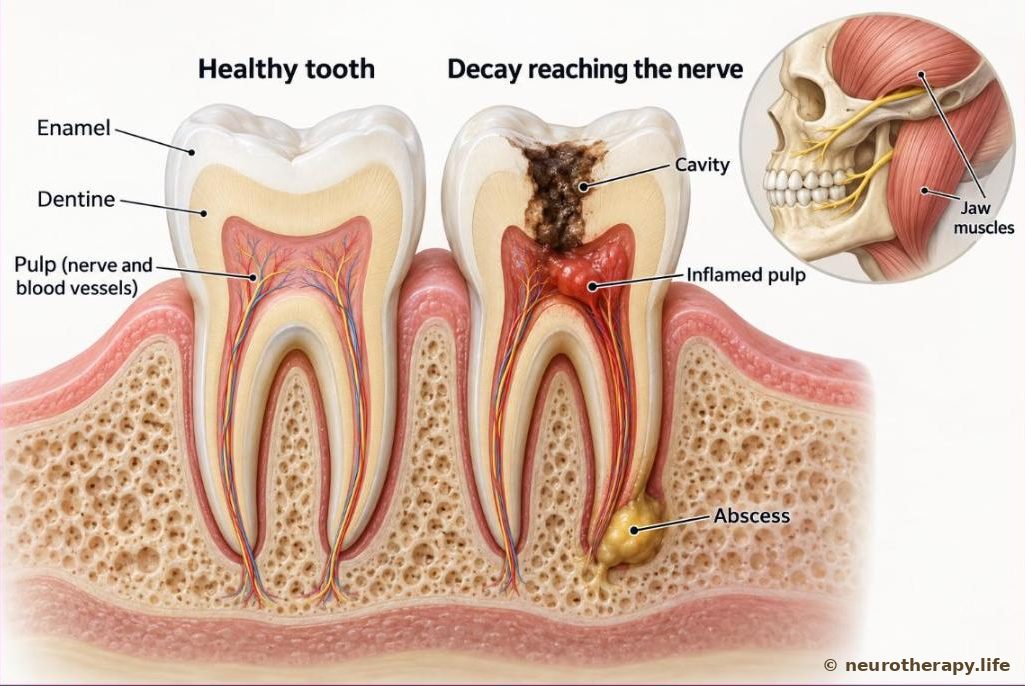
A tooth has a hard outer shell and a soft living centre called the pulp, which holds the nerve and blood vessels. When decay or a crack lets germs reach the pulp, it swells inside its hard box — and that pressure is felt as pain.
Early on, the pain comes and goes, often with cold or hot food. Later it can become constant and throbbing, and hard to point to. Pain can also come from the gums, the jaw joint, a blocked sinus — or from jaw muscles tight from clenching.
What are the symptoms?
- A dull ache, or sharp, throbbing pain in or around a tooth
- Pain when biting or chewing
- Sensitivity to hot, cold or sweet food
- Red or swollen gums
- A bad taste or bad breath
- Headache, fever or pain when opening the mouth wide
What causes it, and who is more likely to get it?
The tooth itself
- Tooth decay (a cavity)
- A cracked or broken tooth
- A loose or broken filling
- Sensitive teeth
Infection
- A dental abscess — a pocket of pus at the root or in the gum
- Gum disease
Jaw and muscles
- Grinding or clenching the teeth
- An injury to the jaw or tooth
How is it found?
A dentist finds the cause by asking about the pain and looking closely. Knowing the cause decides the treatment — a filling, a root canal, or taking the tooth out.
Mouth examination
The dentist checks the teeth, gums, tongue and throat, and may also look at the ears, nose and neck.
Dental X-ray
Shows decay between teeth, and infection or bone loss hidden under the gums.
Questions about the pain
When it started, what sets it off — hot, cold, biting — and whether it wakes you at night.
A neurotherapist asks which side hurts, upper or lower teeth, and whether a dentist has seen it. The jaw muscles are felt — a tender temple muscle when the teeth are clenched points to muscle pain. Liv° and Mu° are checked, because a heparin treatment suited to the body is chosen before the Teeth point.
How Neurotherapy sees Toothache (tooth, gum and jaw pain)
In LMNT teaching, the Teeth point increases the circulation of blood in the teeth and the jaws, and is taught to the patient to do at home. (5) Medulla is given for every problem of the teeth, gums, lips and chewing muscles; (7) Medulla for the upper or lower part of the jaw; and the Jaw point for pains of the teeth and gums. Before the Teeth point, the heparin treatment that suits the patient's body is given. All of this is comfort while the dentist is being arranged — it does not treat decay or an abscess.
Why a tight jaw muscle can feel like toothache
- Clenchingstress or habit keeps the jaw shut tight
- Jaw musclesthe temple and cheek muscles grow tight and sore
- Shared nervethe same nerve branch runs these muscles and carries feeling from the lower teeth
- The brain's readingthe muscle pain is felt as if it were in the teeth
- Jaw pointgiven on both cheeks, where the jaw-closing muscle sits
That is why a therapist feels the jaw muscles as well as asking about the tooth. But the order never changes: a toothache is a symptom with a cause, and the dentist finds that cause.
Only they know the pain; you do not.
Neurotherapy treatment for Toothache (tooth, gum and jaw pain), step by step
Examine first — and arrange the dentist
The therapist checks Liv° and Mu°, asks which side and which teeth hurt, feels the jaw muscles, and makes sure a dentist will see the tooth.
The right heparin first
Before the Teeth point, the heparin treatment that suits the patient's body is given — chosen from the heparin family, whose parent is P. Heparin. No heparin treatment is given while blood is flowing or a wound is open.
(5) Medulla — or (7) for the jaw
(5) Medulla for every problem of the teeth, gums, lips and chewing muscles; (7) Medulla for the upper or lower part of the jaw.
Teeth points — taught to you
On the same side as the pain. Upper teeth: the point above the ear (clench your teeth to find the moving muscle) and below the eye. Lower teeth: below the chin and below the jaw. Press, release, then small clockwise circles where it is tender — on and off through the day, not all at once.
Jaw points
Given by the therapist on both cheeks, near the angle of the jawbone — for pains of the teeth and the gums.
Points and formulas used
Teeth Points
Increases blood circulation in the teeth and jaws; taught to the patient and done on the painful side only, after the right heparin treatment.
Open →Jaw Points
Press-and-release at the angle of the jaw on both cheeks, for pains of the teeth and gums.
Open →Never do this
- A toothache is a symptom with a cause. Decay, an inflamed pulp or an abscess is not treated by a finger on the cheek — these points are comfort while the dentist is arranged, and you should be told so. Teeth Points
- See a dentist or doctor today for swelling of the face or under the jaw, fever, a jaw that will not open fully, difficulty swallowing, or swelling under the tongue. Go to hospital at once if swelling around the eye or neck, or in the mouth, makes it hard to breathe, swallow or speak. Jaw or tooth pain with chest pain, sweating or breathlessness can be a heart attack — call 108 or 112.
- No heparin treatment while blood is flowing or a wound is open — for example, just after a tooth is taken out — until it has healed. The therapist also checks for heart disease, diabetes and cancer before choosing which heparin to give. P. Heparin (plasmin)
- Teething babies: children get half the adult dose and light treatment only, given by a trained therapist. A baby with diarrhoea at all, blood in the stool, sunken eyes, no urine for many hours, floppiness, a fever under 3 months of age, a fit or fast breathing is seen by a doctor the same day.
- Cancer: if the person has cancer, (10) Pan, Thymus, Pit, Lu + Sh, Rt. Ov / Lt. Ov and (30) Medulla are never given — the therapist changes the plan.
- Keep taking the medicines your doctor prescribed. Neurotherapy works alongside your medical care, never instead of it.
From Ayurveda and the kitchen
Teeth in the order of the day
Ayurveda's daily routine (dinacharyā) is a sequence, not a list: rise, empty the bowels, clean the teeth, then the tongue, then the eyes, then oil, exercise, bathe and eat. LMNT formulas rest on the same instinct — the body does its work in an order, and care follows that order.
Test yourself
What research says
- Strong evidence
The maxillary branch of the trigeminal nerve carries feeling from the upper teeth, and the mandibular branch from the lower teeth. The mandibular branch also runs the chewing muscles — which is why a sore jaw muscle can be felt as toothache, and why upper and lower teeth are treated separately.
Price S, Daly DT. Neuroanatomy, Trigeminal Nucleus. StatPearls. 2023.
- Strong evidence
When decay lets germs reach the pulp, it becomes inflamed (pulpitis). At first the pain is mild, comes and goes, and is set off by hot or cold; later it becomes constant, severe and hard to pinpoint — a reason to see a dentist early.
No clinical trial of Neurotherapy in toothache has been published yet. Improvements reported by neurotherapists are clinical observations.
For you
Parents of teething babies
Teething can bring fever or loose motions. LMNT teaching gives half milk and half sago water for the ordinary upset — but a baby who is actually losing fluid needs oral rehydration salts and a doctor.
Older adults
Broken teeth, missing teeth or a loose denture quietly change what you eat. Tell your therapist how many teeth you chew on, and have your mouth seen by a dentist.
People who clench or grind their teeth
Tight jaw muscles can feel like toothache. Tell your dentist about it; the Jaw points may help the muscles relax.
This page explains; it does not diagnose. Neurotherapy works alongside your medical care — keep taking the medicines your doctor prescribed, and see a doctor for any new or severe symptom.