Osteoporosis
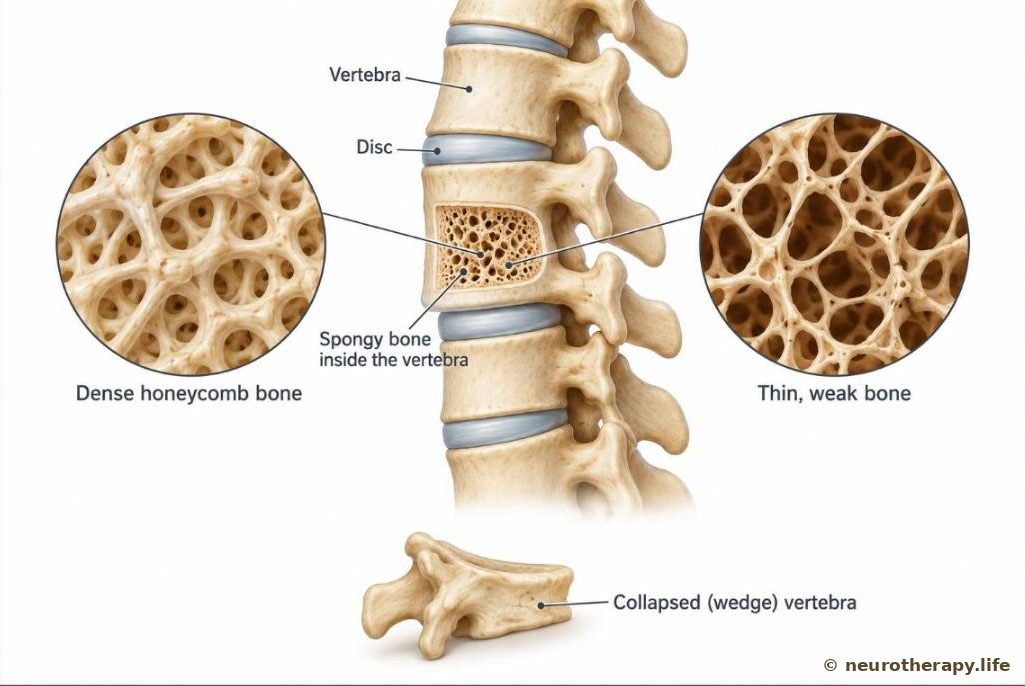
Osteoporosis makes bones thin and weak, so they break easily — sometimes from a small fall, a bump, or even a strong cough.
- A “silent” disease — usually no warning signs until a bone breaks
- 1 in 3 women and 1 in 5 men over 50 will break a bone because of it
- Hip, spine and wrist break most often
Source: International Osteoporosis Foundation; Cleveland Clinic
What is Osteoporosis?
Bone is living tissue. All your life, bone-building cells (osteoblasts) lay down new bone while bone-clearing cells (osteoclasts) remove old bone. Until about age 30 the builders win. After that, clearing slowly runs ahead of building.
In osteoporosis this goes too far. Inside the bone, the fine honeycomb gets thin walls and big holes. The bone still looks normal from outside, but it can no longer carry weight or take a knock.
What are the symptoms?
- Often no symptoms at all in the early years
- Back pain, from a spinal bone that has cracked or collapsed
- Loss of height over time
- A stooped, hunched posture
- A bone that breaks much more easily than expected
What causes it, and who is more likely to get it?
Age and body
- Being over 50
- Women after menopause, as estrogen falls
- A small, thin body frame
- Family history of osteoporosis
Food and sunlight
- Too little calcium in the diet
- Too little vitamin D or sunlight
- Poor digestion, so calcium is not absorbed
Habits
- Little physical activity
- Smoking
- Heavy alcohol use
Medicines
- Long-term steroid tablets
- Some other medicines, such as some acid-reducing tablets and blood thinners
Other conditions
- Thyroid disease
- Diabetes
- Rheumatoid arthritis
- Kidney disease
- Long-standing gut problems
How is it found?
Because osteoporosis is silent, it is usually found by a test — or after a bone breaks.
Bone density T-score
Bone density scan (DEXA): a quick, painless, low-dose X-ray of the hip and spine. It gives a number called the T-score, which compares your bones with those of a healthy young adult.
Source: World Health Organization criteria, as summarised in StatPearls (Porter & Varacallo, 2023)
Blood tests: calcium (normally 9–11 mg/dl), vitamin D, thyroid and kidney function — to look for a cause.
A neurotherapist asks for the bone density report before the first treatment. It changes how you are treated: with the hands only, and with no jerk movements.
How Neurotherapy (LMNT) sees Osteoporosis
Neurotherapy (LMNT) asks a different question. Not “how much calcium did you eat?” but “is your body absorbing it, and putting it where it belongs?” However many calcium tablets a person takes, if the intestine is not absorbing, the calcium never reaches the blood.
The calcium chain — every link must work
- Sunlightfalls on the skin, which makes vitamin D
- Livertakes the first step in changing it
- Kidneysfinish the job, making the active hormone 1,25 DCC
- Intestineabsorbs calcium from food — only with 1,25 DCC present
- Bloodkeeps calcium at 9–11 mg/dl, guided by the parathyroid and thyroid
- Bonestores what the blood does not need
If the kidneys are weak, 1,25 DCC is not made. If digestion is weak, calcium is not absorbed. Neurotherapy (LMNT) works along this chain, starting with digestion.
In this therapy we do not treat the disease; rather, we improve the body.
Neurotherapy (LMNT) treatment for Osteoporosis, step by step
Examine first
The therapist checks the diagnostic pain points Liv° and Mu°, asks for the bone density report, and asks about every tablet you take — including old ones you would not call medicine.
Set digestion right
If undigested food is found, the UDF formula comes first. Calcium cannot be absorbed through a gut that is not working.
The 1,25 DCC formula
Guruji's formula for calcium absorption. It works through points for the liver, the parathyroid, the kidneys and the chest. The version is chosen by the form of the stool that day.
Morning sun
Half an hour of gentle morning sun is part of the formula, not an extra.
Food that feeds bone
Milk, curd, paneer, jaggery and sesame — black sesame has the most. Banana has less calcium and more potassium.
Points and formulas used
1,25 DCC (ordinary form)
Supports the body's own chain for absorbing calcium and laying it into bone.
Works through
Open →Never do this
- Hands only. Never treat with the foot — not even gently.
- Never give (4) Para on its own. Alone, it lifts calcium out of the bone. It is given only inside the full 1,25 DCC formula. (4) Para
- No jerk techniques — Katka, Motor neuron point, P point, the Pradeep jerk, or Abdomen setting where a spinal bone has collapsed. Katka
- Avoid Shukla — it may increase the pain. Shukla
- Keep taking the medicines your doctor prescribed. Neurotherapy (LMNT) works alongside your medical care, never instead of it.
Watch

This video explains the Para point and how (2) Para differs from (4) Para, in relation to low calcium, bone pain and blood pressure.
How digestion is set right first — the UDF treatment.
From practice
The retired postmaster whose back pain came from a pillow
A teaching case — a composite from practice, not one patient's file
66 years · neck pain, giddiness, and new low back pain for six weeks
- What was found
- His bone density report showed osteoporosis — and no one at his previous centre had asked for it. His back pain was worse on treatment days: a pillow placed under his waist had kept his back arched for half an hour at a time.
- What was done
- Hands only. The pillow moved under both thighs. Digestion first, with more water. The waist pain was gone by the fourth day and his stools became daily by week two.
- What it teaches
- In week five his progress stopped. Asked to show everything he put in his mouth, he brought steroid tablets taken for eleven years — a common cause of thin bones. Nothing was stopped; he was sent to his physician with his report.
From Ayurveda and the kitchen
The gond laddu
Villages feed a new mother laddus of edible gum, ghee and nuts, so that the bones of mother and child stay strong. It is the same concern as the 1,25 DCC formula — reached from the kitchen instead of the clinic.
Early sun in the daily routine
Ayurveda's daily routine (dinacharyā) places gentle early sunlight as something to be done, not something that just happens.
Test yourself
What research says
- Strong evidence
The active form of vitamin D (1,25-dihydroxyvitamin D — the “1,25 DCC” of Neurotherapy (LMNT)) is the main hormone that controls how much calcium the intestine absorbs.
- Strong evidence
Bone mass peaks in the third decade of life; after that, bone breakdown gradually exceeds bone formation. A T-score of −2.5 or lower defines osteoporosis.
No clinical trial of Neurotherapy (LMNT) in osteoporosis has been published yet. Improvements reported by neurotherapists are clinical observations.
For you
Women
Bone loss speeds up after menopause. Ask your doctor about a bone density scan, and keep daily sun and calcium-rich food.
Older adults
Short, gentle, hands-only sessions. Prevent falls at home: good light, no loose rugs, a support rail in the bathroom.
People on long-term steroids
Steroids are among the commonest causes of thin bones. Do not stop them yourself — tell your doctor and your therapist.
This page explains; it does not diagnose. Neurotherapy (LMNT) works alongside your medical care — keep taking the medicines your doctor prescribed, and see a doctor for any new or severe symptom.