Eye problems
Eye problems range from a cloudy lens and a damaged eye nerve to red, dry or watering eyes. Many take sight slowly and without pain, so regular eye check-ups matter.
- At least 2.2 billion people worldwide have near or distance vision impairment
- In about 1 billion of them, it could have been prevented or has not yet been treated
- Cataract (94 million) and uncorrected short or long sight (88.4 million) are the top causes of poor distance vision
Source: World Health Organization; National Eye Institute (NIH); MedlinePlus
What is Eye problems?
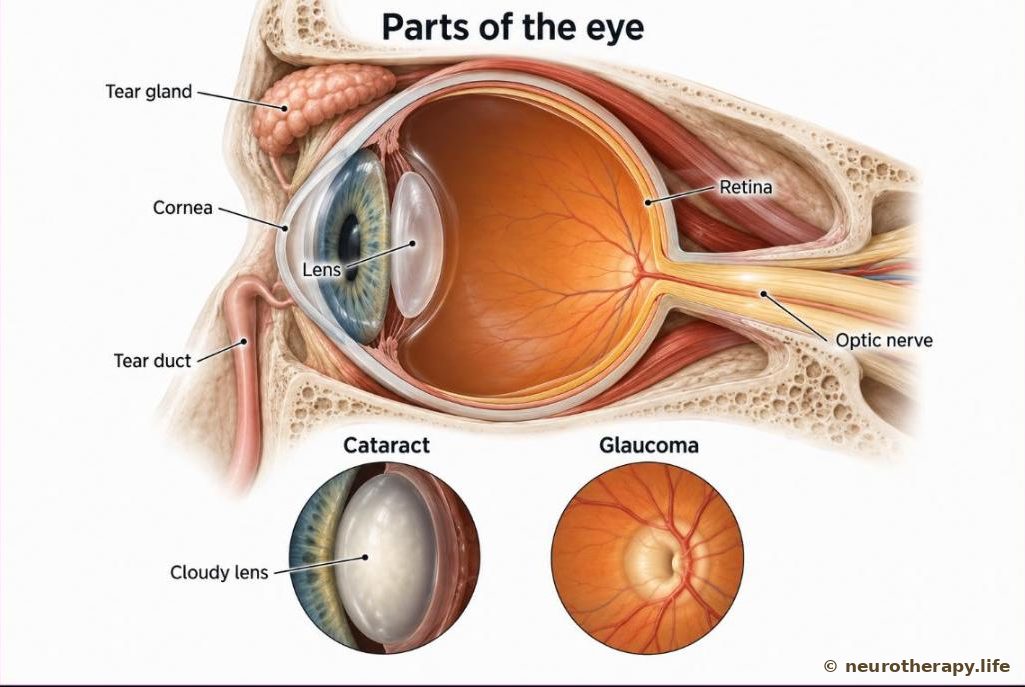
The eye works like a camera. Light passes through the clear front window (cornea) and the lens, which focus it on the retina at the back. The optic nerve carries the picture to the brain. Tears keep the front of the eye wet and clean.
A problem can start in any part. The lens can turn cloudy (cataract). The optic nerve can be slowly damaged (glaucoma), often with no warning. The retina can be harmed by age, diabetes or high blood pressure. The surface can turn red, dry or watery. Sight lost from glaucoma does not come back, which is why early check-ups matter.
What are the symptoms?
- Blurred, dim or cloudy vision
- A sudden change in vision, or flashes of light
- Eye pain or discomfort
- Redness, swelling or discharge
- Constant watering, or dry, gritty eyes
- Double vision
What causes it, and who is more likely to get it?
Age and family
- Getting older — cataract and glaucoma become more common after 60
- Eye disease in the family, such as glaucoma
Other illnesses
- Diabetes, which can damage the retina
- High blood pressure
- Being overweight
The surface of the eye
How is it found?
Most eye diseases are found in a full eye check-up — often before you notice anything yourself.
Vision test
Reading letters on a chart shows how well each eye sees, near and far.
Dilated eye exam
Drops widen the pupils so the doctor can see the lens, the retina and the optic nerve.
Eye pressure and side-vision test
Used to find glaucoma, which usually has no symptoms at first.
Before the first session, a neurotherapist asks what every eye drop you use is for, and whether you have fits, heart disease or cancer. A red, painful eye or any sudden change in sight is sent to the eye doctor first.
How Neurotherapy sees Eye problems
For eye disease in general, LMNT teaching gives the Lacrimal point at the inner corner of the eye — for boils in the eyes, debris, watering for no reason, and alongside glaucoma care. It adds M. Heparin, H Arrow, (4) Thrd and (10) and (18) Pan. For weak sight, (2) Medulla is given first, then the rubbing of Brodmann's areas 17 and 18 at the back of the head. The claim is modest: caring for a tired organ, never replacing the eye doctor.
LMNT corrects its own glaucoma line out loud: glaucoma is damage to the eye's nerve from a fluid that is not draining inside the eye — not a tear-duct problem. So the Lacrimal point is given alongside the eye doctor and the drops, never instead. LMNT also records a woman whose eyes watered for months after an injection; Guruji read it as a medicine's ill effect and gave (6) Adr × 3 once.
In this therapy we do not treat the disease; rather, we improve the body.
Neurotherapy treatment for Eye problems, step by step
Examine first
The therapist checks Liv° and Mu°, reads the eye doctor's reports, and asks what every eye drop is for. A red painful eye or sudden change in sight goes to the eye doctor first.
(30) Lacrimal point
Thirty gentle presses at the inner corner beside the nose, eyes closed, fingers wrapped in a soft handkerchief — never on the eyeball.
M. Heparin
The Heparin formula headed by Medulla, which LMNT lists for eye disease.
H Arrow, (4) Thrd, (10) and (18) Pan
Chosen by the therapist from the examination, each only where its own bars do not apply.
For weak sight: (2) Medulla, then Brodmann's 17 & 18
(2) Medulla first, then the rubbing at the back of the head — the order is part of the treatment.
Points and formulas used
Lacrimal Point
At the inner corner of the eye — for dryness, constant watering and debris; given alongside glaucoma care, never instead.
Open →M. Heparin (medulla)
The Heparin formula headed by Medulla — LMNT lists it for eye disease, headache and brain circulation.
Works through
Open →H Arrow
Worked between the shoulders at the base of the neck — one of LMNT's points for eye disease.
Open →(4) Thrd
The thyroid point for metabolism. In heart patients, LMNT gives (2) Thrd in its place.
Open →(2) Medulla
Works on the second cranial nerve, the nerve of sight; followed by Brodmann's 17 & 18 rubbing.
Open →Never do this
- Glaucoma: keep your eye drops and your eye-doctor appointments. The Lacrimal point is given alongside, never instead — sight lost to glaucoma does not come back. Lacrimal Point
- Never press on the eyeball. No eye point in a red painful eye, sudden loss of sight, after an eye injury or recent eye surgery, or with a hot, red, tender swelling at the inner corner.
- Pan is not given in fits, convulsions or seizures (except inside a Heparin formula), nor in schizophrenia. Pan
- Go to an eye hospital the same day for sudden severe eye pain with blurred sight, haloes around lights, red eye and vomiting, or for any sudden change or loss of vision.
- Cancer: if the person has cancer, (10) Pan, Thymus, Pit, Lu + Sh, Rt. Ov / Lt. Ov and (30) Medulla are never given — the therapist changes the plan.
- Keep taking the medicines and eye drops your doctor prescribed. Neurotherapy works alongside your medical care, never instead of it.
Watch

A demo of the M. Heparin formula — the Heparin formula headed by Medulla ((6) Medulla, (8) Pan, (7) Liv, (8) Chest Only) — used for neck and shoulder pain and for headache that keeps coming back.
How M. Heparin is given. The video shows it for neck pain and headache; LMNT also lists the same formula for eye disease.
From practice
The retired schoolmaster who had stopped his drops
A teaching case — a composite from practice, not one patient's file
66 · retired schoolmaster · a daily headache across the forehead and behind both eyes for about a year
- What was found
- Tight brow and tender temples — an ordinary tension-type headache. But he had used hospital eye drops for three years, and had stopped them last month because the headache did not go. His reading glasses had changed twice in two years. He did not know what the drops were for.
- What was done
- Nothing was given on the first day except an explanation: those drops are for a silent pressure in the eye that takes sight slowly and does not give it back. He restarted them and went to the eye department; the tests showed raised pressure and changes in his side vision he had not noticed. Only then did the headache work begin.
- What it teaches
- Ask what every medicine is for. A drop that 'did not help' a headache may be protecting sight — no patient should stop it because of a therapy session.
From Ayurveda and the kitchen
Trāṭaka and palming
The yoga texts give two eye practices: steady gazing at a small flame until the eyes water (trāṭaka), and its opposite — rubbing the palms warm and cupping them over closed eyes, touching nothing, until the darkness is complete. Like the Lacrimal point, neither claims to treat an eye disease; both care for a tired organ.
Test yourself
What research says
- Strong evidence
Pressure inside the eye strains the spot where the optic nerve leaves the eye, and its nerve fibres slowly die. Glaucoma is a leading cause of sight loss that cannot be reversed; treatment slows it down.
No clinical trial of Neurotherapy in eye problems has been published yet. Improvements reported by neurotherapists are clinical observations.
For you
People over 60, or with glaucoma in the family
Get a dilated eye exam regularly — glaucoma takes sight without pain or warning.
People with diabetes or high blood pressure
Both can harm the retina. A yearly eye check-up is worth keeping.
Anyone using eye drops
Know what each drop is for, and never stop one without asking your eye doctor.
This page explains; it does not diagnose. Neurotherapy works alongside your medical care — keep taking the medicines your doctor prescribed, and see a doctor for any new or severe symptom.