Obesity
Obesity means carrying so much body fat that it starts to harm health. It raises the risk of diabetes, heart disease, high blood pressure and painful joints.
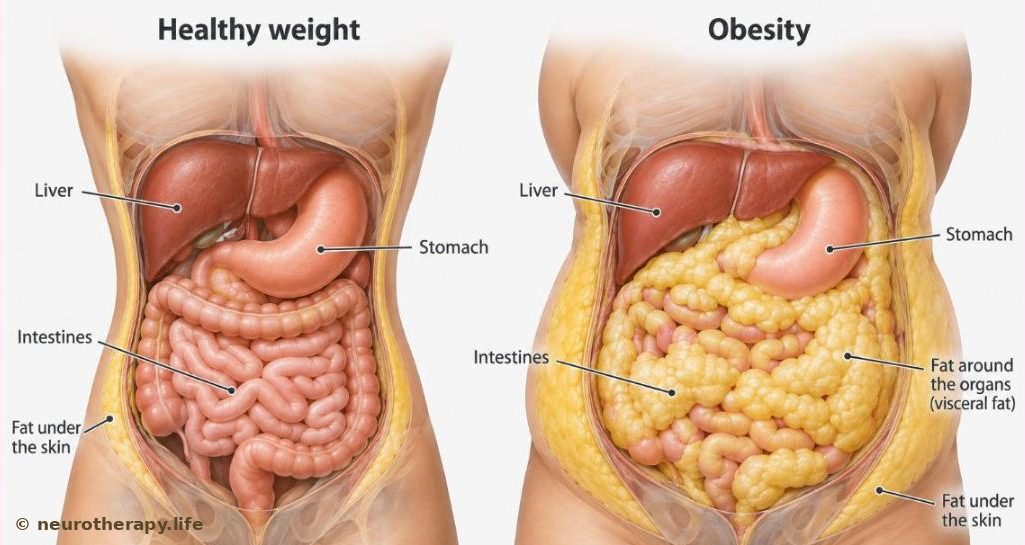
- 890 million adults worldwide were living with obesity in 2022
- 43% of adults were overweight, and 16% had obesity
- In Asian people, health risks begin to rise from a BMI of 23
Source: World Health Organization (Obesity and overweight fact sheet); Mayo Clinic
What is Obesity?
Your body stores spare energy as fat. Some fat is needed — it keeps you warm, cushions the organs and holds a reserve of fuel. When more energy comes in from food than the body uses, the store keeps growing.
Obesity is when that store becomes large enough to harm health. It is not only about eating: genes, sleep, stress, some medicines and hormone problems such as an underactive thyroid all play a part.
What are the symptoms?
- A large waist — above 102 cm in men or 89 cm in women
- Getting out of breath easily, e.g. on stairs
- Pain in the knees, hips or back
- Snoring, and feeling sleepy in the day
- Tiredness and low energy
What causes it, and who is more likely to get it?
Food and activity
- Eating more calories than the body uses
- Sugary drinks and alcohol
- Long hours of sitting and screen time
Family and age
- Parents who are heavy — shared genes and shared habits
- Getting older, with less muscle
- Weight kept on after pregnancy
Health problems and medicines
- An underactive thyroid
- Some medicines, such as steroids and some antidepressants
Daily life
- Too little sleep
- Stress and eating to cope
- Weight gain after quitting smoking
How is it found?
A doctor weighs and measures you, works out your BMI, measures your waist, and may order blood tests to look for a cause and for problems that come with weight.
BMI (body mass index)
Your weight in kilograms divided by your height in metres, squared. It is a quick guide, but it cannot tell fat from muscle and bone.
Waist measurement
Fat around the belly carries the most risk. A waist above 102 cm in men or 89 cm in women raises the risk of heart disease and diabetes.
Blood tests
Sugar, cholesterol and triglycerides, and thyroid function — to look for a cause and for problems that often come with weight.
BMI for adults (kg/m²)
Source: Mayo Clinic; MedlinePlus, US National Library of Medicine
A neurotherapist asks for the thyroid report, because in Neurotherapy (LMNT) the point given for obesity is chosen chiefly where the weight has come with an underactive thyroid. The therapist also looks in the mouth and asks how many teeth you chew on — advice to chew well is only useful to a mouth that can.
How Neurotherapy (LMNT) sees Obesity
Neurotherapy (LMNT) looks at weight through digestion. Its rule for the plate is simple: chew well. Chewing brings out more saliva, which begins to digest chapati, rice and other starches in the mouth. The movement of the jaws, the therapy teaches, keeps the nerves of the brain — and through them the digestive system — working properly.
And if the fats in the food are not digested properly, from that too obesity can increase. Note the word “too”: it is one cause among many, not the whole story. On the table, (10) Pan is given to reduce triglycerides — the fats in the blood — chiefly where the weight has come with an underactive thyroid.
The patient has to try it for himself and see. Every single thing will not have the same effect on every person.
Neurotherapy (LMNT) treatment for Obesity, step by step
Examine first
The therapist asks for the thyroid, sugar and lipid reports, looks at the teeth, and asks what the day's meals are. The day's plan follows the day's body.
(10) Pan
(10) Pan stimulates the pancreas to make insulin. In obesity it is given to reduce triglycerides, chiefly where the weight has come with an underactive thyroid.
Chew well
Chew each mouthful well, so that more saliva comes. Try it: chew a plain piece of chapati thirty times without swallowing — it turns sweet in your mouth. That is the saliva at work.
The order of the meal
Sit on the floor to eat, not on a chair with the feet hanging. Drink water half an hour before the meal, not in the middle. After eating, sit a while and do the sitting tasks — for children, give breakfast fifteen minutes earlier so they need not run for the bus.
Points and formulas used
Never do this
- Pan is not given in fits, convulsions or seizures, because it increases alkali (it may still be given inside the Heparin formula). Pan is not given in schizophrenia. Pan
- Before advising “chew well”, look at the teeth. Broken or missing teeth, a loose denture or a painful jaw need a dentist, and food prepared differently.
- Chest pain or pressure, or pain between the shoulder blades in someone with heart risk, is an emergency — see a doctor at once, not a therapist.
- Cancer: if the person has cancer, (10) Pan, Thymus, Pit, Lu + Sh, Rt. Ov / Lt. Ov and (30) Medulla are never given — the therapist changes the plan.
- Keep taking the medicines your doctor prescribed. Neurotherapy (LMNT) works alongside your medical care, never instead of it.
From Ayurveda and the kitchen
Test yourself
What research says
- Strong evidence
A review of 17 trials found that chewing food longer reduced how hungry people felt, and in most experiments reduced how much they ate. More chews per bite also raised the gut hormones that signal fullness.
- Strong evidence
When the thyroid is underactive, the body clears fats from the blood more slowly, so cholesterol and often triglycerides rise. This is the link between the thyroid and blood fats that Neurotherapy (LMNT)'s (10) Pan rule points to.
No clinical trial of Neurotherapy (LMNT) in obesity has been published yet. Improvements reported by neurotherapists are clinical observations.
For you
Parents of schoolchildren
Move breakfast fifteen minutes earlier: shoes and bag first, then eat, then the sitting tasks. A habit started young outlasts every diet.
People with an underactive thyroid
Weight can come with the thyroid. Keep your thyroid reports up to date and show them to your therapist; do not change your thyroid tablets yourself.
Everyone carrying extra weight
Losing even 5–10% of your weight can delay or prevent the diseases that come with it. Small, steady changes count.
This page explains; it does not diagnose. Neurotherapy (LMNT) works alongside your medical care — keep taking the medicines your doctor prescribed, and see a doctor for any new or severe symptom.