Hypothyroidism
Hypothyroidism means the thyroid gland in your neck makes too little of its hormones, so the whole body slows down — you feel tired and cold, gain weight, and the bowel becomes sluggish.
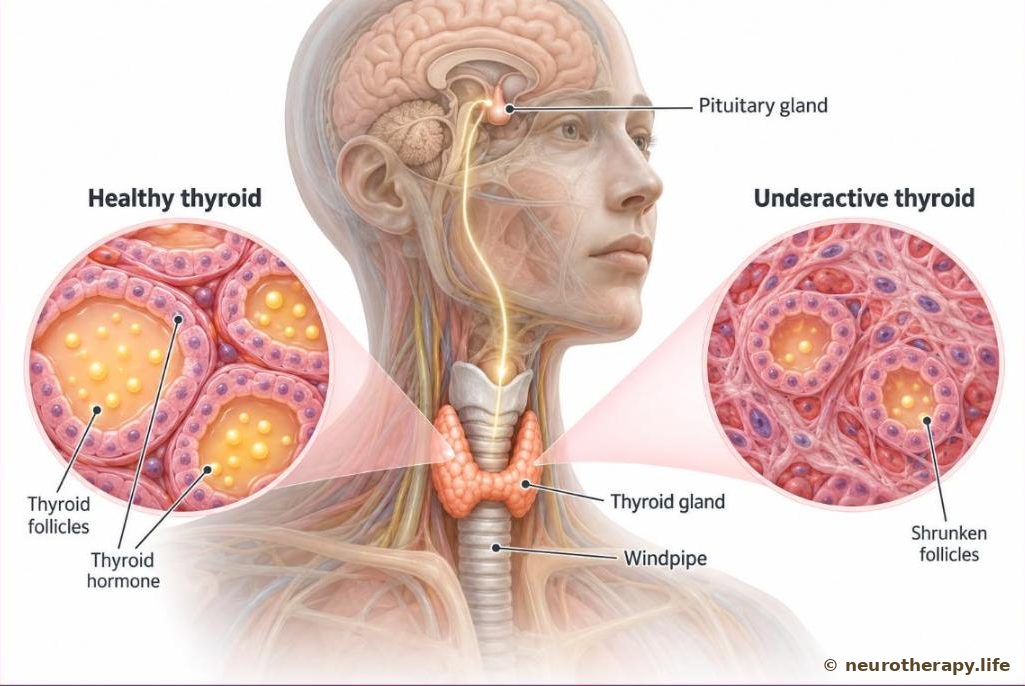
- Nearly 5 in 100 people aged 12 and older have it (US figures) — most cases are mild
- Much more common in women, and in people over 60
- It comes on slowly — symptoms can go unnoticed for months or even years
Source: US National Institute of Diabetes and Digestive and Kidney Diseases (NIDDK); MedlinePlus
What is Hypothyroidism?
The thyroid is a small, butterfly-shaped gland at the front of your neck. Its hormones, T₃ and T₄, set the speed at which your body uses energy — your heartbeat, your digestion, your body warmth, even your mood.
The pituitary gland in the brain sends the thyroid an order called TSH. When the thyroid does not answer, the pituitary sends more TSH — so a high TSH on a report means a slow thyroid. The most common cause is Hashimoto's disease, where the body's defence system attacks the gland. A goitre is a thyroid that has swollen.
What are the symptoms?
- Tiredness, slow thinking and forgetfulness
- Weight gain and a puffy face
- Feeling cold when others do not
- Constipation
- Dry skin and dry, thinning hair
- Heavy or irregular periods; sometimes a swelling at the front of the neck (goitre)
What causes it, and who is more likely to get it?
The immune system
Treatment to the thyroid
- Surgery that removed part or all of the gland
- Radiation treatment to the neck or thyroid
- Certain medicines
Other causes
- Thyroiditis — inflammation of the thyroid
- Too little iodine in the diet
- Rarely, a problem in the pituitary gland
Who is at higher risk
- Women, especially after pregnancy or after 60
- A family history of thyroid disease
- An earlier thyroid problem, such as a goitre
How is it found?
A slow thyroid is found with a blood test. Because the symptoms are common and come on slowly, the test is what settles it.
TSH
The main test. A high TSH means the pituitary is pushing hard on a thyroid that is not answering.
T₄ and T₃
The thyroid's own hormones. Low levels, with a high TSH, confirm an underactive gland.
Antibodies and scans
A thyroid antibody test looks for Hashimoto's disease. An ultrasound or thyroid scan may be used if the neck is swollen.
A neurotherapist asks for your TSH with the free T₄ beside it — so progress can be judged against them in about three months — and your haemoglobin if you are tired. A child with very hard constipation who is slow at school is sent for a thyroid blood test.
How Neurotherapy (LMNT) sees Hypothyroidism
In Neurotherapy (LMNT) the thyroid is the mistrī — the chief craftsman, without whose order the other glands and organs do not get on with their work. And the craftsman needs raw material: tyrosine, the building block of thyroid hormone, is made from protein during digestion. So a thyroid report is very often a report about a stomach.
The thyroid chain — and the loop that closes it
- Digestionreleases tyrosine from the protein you eat
- Thyroiduses it to make T₃ and T₄
- Pituitaryraises TSH when the thyroid does not answer
- Bowelslows when the gland runs low — the stool dries and hardens
- Blood calciumbelow 9 mg/dl, the muscles beside the glands cannot work well — and the gland runs slower still
So the work begins in the kitchen, not at the neck. On the same reasoning Guruji thought the 1,25 DCC formula for calcium would help people with hypothyroidism — especially children with mental slowness because of it.
It is not enough that one eats protein. The thing that matters is that it is digested.
Neurotherapy (LMNT) treatment for Hypothyroidism, step by step
Examine first
The therapist checks the diagnostic pain points Liv° and Mu°, presses gently around the navel for Pan and Const, and reads the TSH and free T₄.
Digestion first
If the navel points are tender and the bowel is slow, digestive work comes first — sometimes for several sessions before any gland treatment. Const is given for the constipation of a slow thyroid.
The thyroid point
(4) Thrd raises metabolism through T₃ and T₄. It is given with the flat of the palm, mild pressure, released at once. In the teaching case, the adrenal was given before the thyroid, not after — the order is part of the treatment.
P. Heparin and 1,25 DCC
P. Heparin is listed for hypothyroidism. The 1,25 DCC formula is used where there is mental slowness with hypothyroidism, especially in children.
Goitre, and what follows from a slow thyroid
For goitre, LMNT teaching gives (2) Pan, and (10) Pan for those who do not benefit from it — a line it marks with its own question mark. Where diabetes or heart disease has come from hypothyroidism, (10) Pan is used; in heart patients, (2) Thrd replaces (4) Thrd.
Points and formulas used
P. Heparin (plasmin)
The parent Heparin formula, written as one that can be given to all patients; listed for hypothyroidism.
Works through
Open →Never do this
- A goitre, or a thyroid running fast: no work on the neck at all. No pressure ever falls on the front or sides of the neck, by foot or by hand. Neck
- No (4) Thrd in heart patients — (2) Thrd instead. Not in asthma, where the cough increases, and not in bamboo spine or spur. (4) Thrd
- Thrd is given with the flat of the palm, mild and released at once — never a fingertip, never a hold. Thrd
- A neck swelling with difficulty breathing or noisy breathing needs emergency help. New neck pain or an unusual headache with disturbed vision, slurred speech or numbness: stop, and see a doctor at once.
- Cancer: if the person has cancer, (10) Pan, Thymus, Pit, Lu + Sh, Rt. Ov / Lt. Ov and (30) Medulla are never given — the therapist changes the plan.
- A slow thyroid is diagnosed by a blood test and treated with a tablet. Keep taking the medicines your doctor prescribed — never stop the tablet because a pain point has gone quiet. Neurotherapy (LMNT) works alongside your medical care, never instead of it.
Watch

A step-by-step training demo of a hypothyroidism formula: Half Kundli for 40 seconds on the edge of a chair, (6) Medulla on both sides of the neck, 4 Thyroid-P near the elbow and shoulder, and 4 Thyroid at the base of the neck. It is given in one go, without gaps, to support a slow thyroid.
Note: LMNT teaching gives Thrd with the flat of the palm, never a fingertip, and no neck work with goitre. Keep taking your thyroid tablet.

Shows how to give yourself 1 point Gal, 1 point Liv and 1 point Mucus on the thighs and forearms, six times with a one-minute gap, before and after meals. It is shared as home support for the weight gain and tiredness of an underactive thyroid.
Note: this routine supports digestion; it does not replace your thyroid tablet.
A step-by-step training demonstration of a thyroid treatment, in Hindi.
From practice
The teacher whose thyroid report would not settle
A teaching case — a composite from practice, not one patient's file
44 years · tiredness, weight gain and a raised TSH for three years
- What was found
- “They keep increasing the tablet and I keep getting more tired.” Cold hands, thinning hair, dry skin on the shins — and, asked directly, hard motions every two or three days, “but that is normal for me.” She was tender at Pan and Const, and startled by both: “There is nothing wrong with my stomach.”
- What was done
- Not “a treatment for hypothyroidism”. Digestive work was given for nine sessions before any gland treatment was added — so that the protein she ate could release what her thyroid needed. When gland work began, the adrenal came before the thyroid. The bowel moved daily by week two; at week seven her own physician found the TSH lower and left her dose unchanged.
- What it teaches
- In week nine she slipped back for a fortnight. Asked what her mornings looked like now, she said school had reopened and she was eating lunch standing in a corridor in eleven minutes. Nothing in the treatment was wrong — the complaints she thought trivial (hair, skin, bowel) were the ones that showed first whether it was working.
From Ayurveda and the kitchen
Test yourself
What research says
- Strong evidence
A major review of hypothyroidism: it is common, it is diagnosed with blood tests for TSH and free T₄, and its main causes are too little iodine worldwide and autoimmune thyroid disease where iodine is enough.
Chaker L, Bianco AC, Jonklaas J, Peeters RP. Hypothyroidism. Lancet. 2017.
No clinical trial of Neurotherapy (LMNT) in hypothyroidism has been published yet. Improvements reported by neurotherapists are clinical observations.
For you
Women
Hypothyroidism is far more common in women, especially after a pregnancy and after 60. Heavy or irregular periods with tiredness are worth a thyroid test.
Children
A child with very hard constipation and a school report saying he is slow deserves a simple thyroid blood test — a correctable cause should not be missed.
People on a thyroid tablet
Take it as your doctor set it, and have the TSH rechecked when your doctor advises. Only your doctor changes the dose.
This page explains; it does not diagnose. Neurotherapy (LMNT) works alongside your medical care — keep taking the medicines your doctor prescribed, and see a doctor for any new or severe symptom.