Gallstones
Gallstones are hard lumps that form in the gallbladder, a small pouch under the liver that stores bile. Most people with gallstones never feel them. When a stone blocks the way out, it can cause sudden, severe pain in the upper right belly.
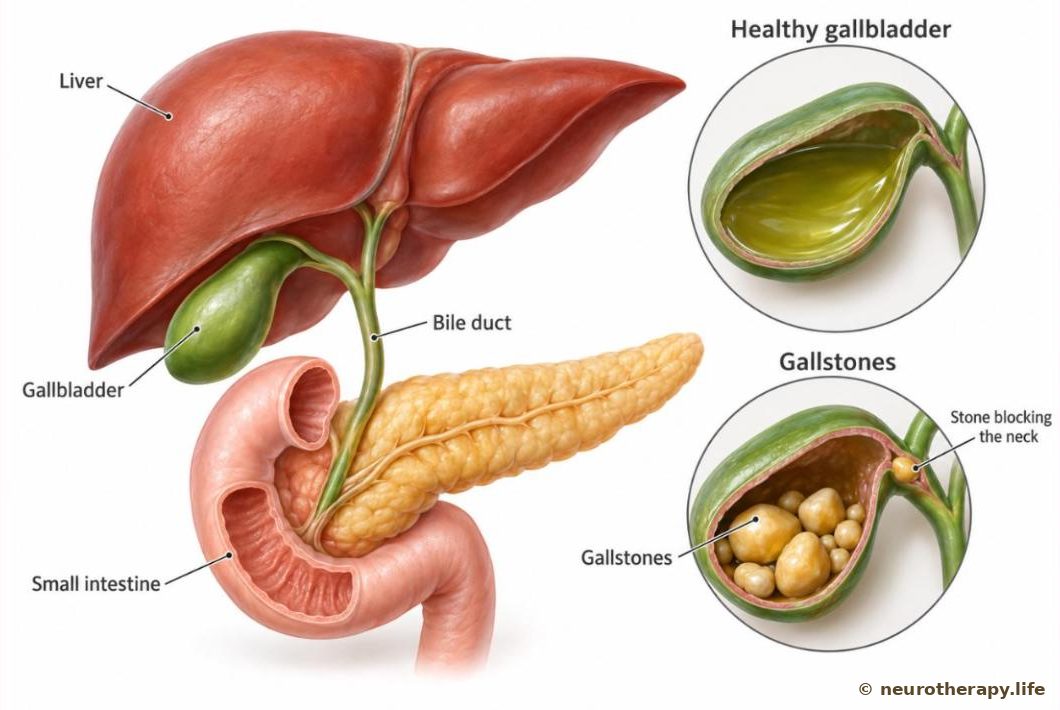
- At least 10% of adults in the USA have gallstones
- Up to 75% of them are women
- Only about 20% ever get symptoms or need treatment
Source: Cleveland Clinic; MedlinePlus
What is Gallstones?
Your liver makes bile, a yellow-green digestive juice. The gallbladder stores it and squeezes it out through the bile duct into the small intestine after a meal, to help digest fat.
Bile holds cholesterol, bile acids and other substances in balance. When there is too much cholesterol, too little bile acid, or the gallbladder does not empty well, the extra settles out as crystals that grow into stones. Most stones are cholesterol stones; others are pigment stones, made from bilirubin.
What are the symptoms?
- Often no symptoms at all
- Sudden, severe pain in the upper right belly, often after a meal
- Pain that spreads to the back or the right shoulder
- Nausea or vomiting
- If a duct is blocked: yellow eyes or skin, dark urine, pale stools, fever
What causes it, and who is more likely to get it?
What is in the bile
- Too much cholesterol in the bile
- Too little bile acid to keep it dissolved
- Too much bilirubin, as in some blood disorders
A slow gallbladder
- The gallbladder not emptying fully, so bile stands still
Who is more at risk
- Women — about three times more than men
- Being overweight, or losing weight very fast
- Pregnancy
- Older age, and gallstones in the family
How is it found?
Many gallstones are found by chance on a scan done for something else. When there is pain, tests show whether a stone is there and whether it is blocking a duct.
Abdominal ultrasound
The main test — a painless scan that shows stones in the gallbladder.
Blood tests
Liver tests and a blood count look for a blocked duct or infection.
HIDA scan, MRCP or ERCP
Special scans that show how the gallbladder empties and whether a stone is stuck in the bile ducts.
A neurotherapist asks for the ultrasound report and checks Liv° and Mu° as always. One question comes before any liver point is given: is there any cancer in the liver? If so, the liver points are not used.
How Neurotherapy (LMNT) sees Gallstones
Guruji's teaching says little about gallstones, and says it carefully. It records one point for them — (12) Liv, the liver point given at a count of twelve — as very beneficial for gallstones, and it offers a reason with a question mark attached: perhaps it works something like cholic acid.
Cholic acid is one of the main bile acids your liver makes, and bile acids are what keep cholesterol dissolved in bile. The word "perhaps" is the therapy's own and is kept: it is a reasoned guess, offered for research, not a proven finding. The Liv point is also described as helping fat digestion and lowering blood cholesterol.
Wherever there is a question mark, it is an indication that this is my own thinking, on which other people can now do research.
Neurotherapy (LMNT) treatment for Gallstones, step by step
Examine first
The therapist checks Liv° and Mu°, reads the ultrasound report, asks whether there is any cancer in the liver, and asks about every tablet you take.
(12) Liv
The liver point, given to the right of the navel at a count of twelve. LMNT teaching records it as very beneficial for gallstones.
Stay with your doctor
Gallstones that cause attacks need a doctor's plan. Neurotherapy (LMNT) is given beside it, and any warning sign below goes to hospital first.
Points and formulas used
Never do this
- If there is cancer in the liver, the Liv points, including (12) Liv, are not given. (12) Liv
- Go to hospital the same day for yellow eyes or skin with fever, for severe pain in the upper right belly that lasts for hours, or for pain with vomiting that will not stop.
- Cancer: if the person has cancer, (10) Pan, Thymus, Pit, Lu + Sh, Rt. Ov / Lt. Ov and (30) Medulla are never given — the therapist changes the plan.
- Keep taking the medicines your doctor prescribed. Neurotherapy (LMNT) works alongside your medical care, never instead of it.
From Ayurveda and the kitchen
Test yourself
What research says
- Strong evidence
About one adult in five develops gallstones. Most are cholesterol stones: they form when bile carries more cholesterol than its bile acids and phospholipids can keep dissolved, and when the gallbladder empties slowly. This is the bile-acid balance Guruji's "perhaps like cholic acid" points to.
No clinical trial of Neurotherapy (LMNT) in gallstones has been published yet. Improvements reported by neurotherapists are clinical observations.
For you
Women
Women are about three times more likely to get gallstones, and pregnancy raises the risk. Always tell your therapist if you are pregnant.
People losing weight
Losing weight very fast can itself bring on gallstones. Slow and steady is safer.
Stones found by chance
Most stones found on a scan never cause trouble. Know the warning signs, and keep your doctor informed.
This page explains; it does not diagnose. Neurotherapy (LMNT) works alongside your medical care — keep taking the medicines your doctor prescribed, and see a doctor for any new or severe symptom.