Dry eyes
Dry eyes happen when your tears cannot keep the front of the eye wet and smooth. The eyes feel gritty, sting or burn — and, oddly, can even water.
- Nearly 16.4 million people in the United States have dry eye
- More common after age 50, and in women
- Watery eyes can be a sign of dry eye — the eye's answer to irritation
Source: National Eye Institute (NIH); Mayo Clinic
What is Dry eyes?
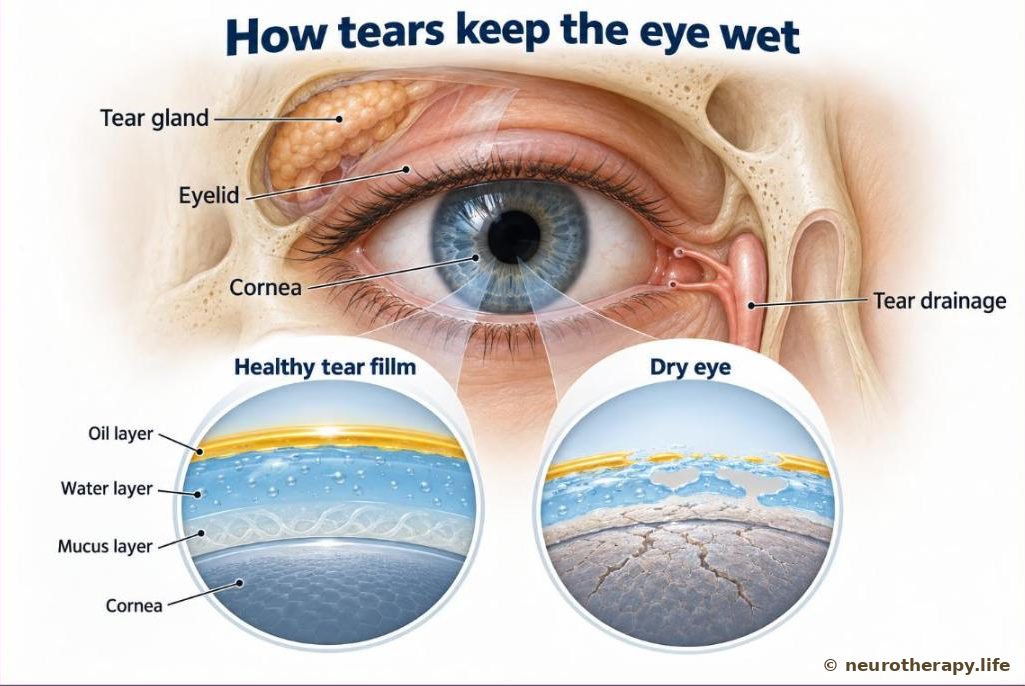
Every blink spreads a thin film of tears over the front of the eye. This film has three layers: oil on the outside to stop it drying, water in the middle, and mucus that makes it stick to the eye. It keeps the eye wet, smooth and clear.
In dry eye, either the eyes make too few tears, or the tears dry up too fast — often because the oil layer is poor. The surface of the eye gets irritated and inflamed. Left untreated for long, severe dry eye can harm the clear front window of the eye, the cornea.
What are the symptoms?
- A scratchy feeling, as if something is in the eye
- Stinging or burning
- Red eyes
- Sensitivity to light, and blurred or tired vision
- Watery eyes, as the eye reacts to the dryness
What causes it, and who is more likely to get it?
Fewer tears made
- Getting older
- Conditions where the body attacks its own glands and joints, such as rheumatoid arthritis, lupus or Sjögren's syndrome
- Some medicines, such as allergy tablets and some tablets for low mood
Tears drying too fast
- Blocked oil glands in the eyelids
- Blinking less — long hours at a computer, tablet or phone
- Wind, smoke or dry air
Other risks
- Wearing contact lenses, or past eye surgery for glasses
- Too little vitamin A or omega-3 fats in the diet
- Hormone changes in women
How is it found?
Dry eye is found in an eye check-up. The doctor looks at the tears themselves.
Full eye examination
The doctor looks at the eyelids, how you blink and the surface of the eye.
How many tears you make
A simple test measures the amount of tears your eyes produce.
How fast tears dry
The doctor checks how quickly the tear film breaks up and dries on the eye.
Before the first treatment, a neurotherapist asks whether you have diabetes, high blood pressure, cancer or fits — because the main point for dry eyes, Pit, is not given in any of these.
How Neurotherapy sees Dry eyes
LMNT teaching gives the pituitary point, Pit, to fill water anywhere in the eye, the ear or the brain — and names the lack of moisture in the eyes, dry eyes, among its uses.
After Pit, (4) Up Arrow is given. Two more points work closer to the tears: the Lacrimal point at the inner corner of the eye, and (7) Medulla, given to increase the flow of tears.
Neurotherapy treats according to the condition of the body.
Neurotherapy treatment for Dry eyes, step by step
Examine first
The therapist checks the diagnostic points Liv° and Mu°, and asks about diabetes, blood pressure, cancer and fits before deciding whether Pit can be given.
Pit, then (4) Up Arrow
Only when none of Pit's bars applies. Pit is given on both arms with the patient lying on the back; (4) Up Arrow follows, with the palm over the lowest bone of the lower back.
The Lacrimal point
Given very gently at the inner corner of the eye, beside the nose, with the fingers wrapped in a soft handkerchief.
(7) Medulla
Given to increase the flow of tears.
Points and formulas used
Pit
The pituitary point — given in LMNT to fill moisture in the eye; followed by (4) Up Arrow. Never in diabetes, high BP, cancer or fits.
Open →Lacrimal Point
At the inner corner of the eye — the tear point, given gently through a soft cloth.
Open →Never do this
- Never give Pit in diabetes (it raises sugar), high BP, cancer or fits. Pit
- The Lacrimal point sits right beside the eye — only a trained therapist gives it, gently and through a soft cloth. Lacrimal Point
- See an eye doctor soon if your eyes stay red, painful or irritated, and at once if you have sudden blurred or lost vision, strong eye pain or strong sensitivity to light.
- Cancer: if the person has cancer, (10) Pan, Thymus, Pit, Lu + Sh, Rt. Ov / Lt. Ov and (30) Medulla are never given — the therapist changes the plan.
- Keep taking the medicines and eye drops your doctor prescribed. Neurotherapy works alongside your medical care, never instead of it.
From Ayurveda and the kitchen
Test yourself
What research says
- Strong evidence
Sensory and motor nerves control how much water, salt and protein the tear gland releases. Small changes in what the tears contain go with dry eye — so the nerve control of the tear gland matters.
No clinical trial of Neurotherapy in dry eyes has been published yet. Improvements reported by neurotherapists are clinical observations.
For you
Screen users
We blink less while looking at a screen. Take short breaks, look away and blink fully.
People with diabetes or high blood pressure
Pit is not given to you. Tell your therapist about both before the first session.
Women over 50 and contact lens wearers
Dry eye is more common in both groups. Mention gritty or burning eyes at your next eye check-up.
This page explains; it does not diagnose. Neurotherapy works alongside your medical care — keep taking the medicines your doctor prescribed, and see a doctor for any new or severe symptom.