Hearing loss (deafness)
Hearing loss means not hearing as well as before — in one ear or both, a little or a lot. Sometimes a simple block such as wax is the cause; sometimes the inner ear or the hearing nerve is worn, which is usually lifelong.
- About 1 in 5 people in the world — over 1.5 billion — live with some hearing loss
- 430 million people, including 34 million children, have hearing loss serious enough to need help
- Nearly 60% of hearing loss in children comes from causes that can be prevented
Source: GBD 2019 Hearing Loss Collaborators, The Lancet 2021; WHO fact sheet on deafness and hearing loss (2026); MedlinePlus; NHS
What is Hearing loss (deafness)?
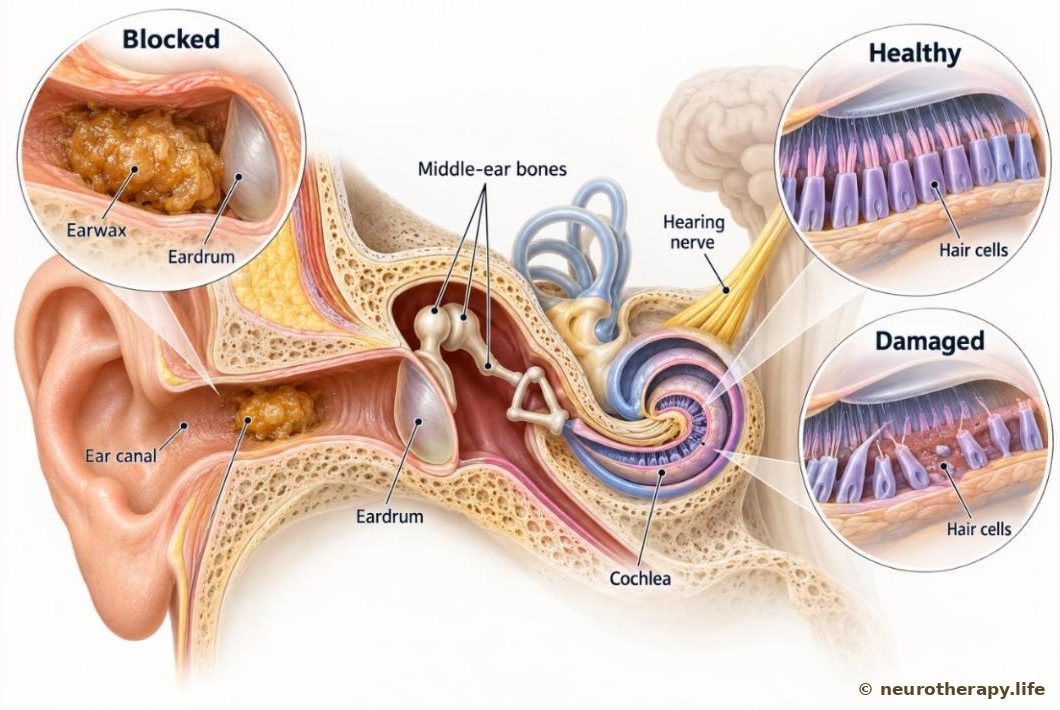
Sound goes down the ear canal, shakes the eardrum and three tiny bones, and reaches the cochlea — a snail-shaped tube in the inner ear. There, rows of tiny hair cells turn the sound into nerve signals, and the hearing nerve carries them to the brain.
There are two main kinds of hearing loss. In conductive loss, sound cannot get through — wax, fluid or a hole in the eardrum is in the way. Treatment or surgery can often put this right. In sensorineural loss, the hair cells or the hearing nerve are damaged — by age, noise, illness or genes. This kind usually lasts for life, and hearing aids or implants help. Some people have both.
What are the symptoms?
- Difficulty hearing people clearly, especially in noisy places
- Often asking people to repeat themselves
- Keeping the TV or phone louder than others like
- Feeling tired after listening for a long time
- Ringing or buzzing in the ears
- In children: slow speech, not responding to sounds, or falling behind at school
What causes it, and who is more likely to get it?
Age and noise
- Wear of the inner ear with age
- Loud noise over years — work, functions, loud headphones
Blockage and infection
- Earwax build-up
- Ear infections and fluid behind the eardrum
- A hole in the eardrum
Inner ear and nerve problems
- Ménière's disease or labyrinthitis
- Meningitis and other serious infections
- Some medicines that harm the ear
- A head injury
Before and around birth
- Genes passed down in the family
- Infections in pregnancy, such as rubella
- Lack of oxygen at birth, severe jaundice or low birth weight
How is it found?
The doctor asks when the hearing changed, in which ear, and whether there is pain, discharge, ringing or giddiness, then looks into the ears. Often an ear, nose and throat (ENT) specialist and an audiologist see you next.
Ear examination
Looks for wax, infection, fluid or a hole in the eardrum — causes that can often be treated.
Hearing test (audiometry)
Measures how softly each ear can hear sounds of different pitches, and shows whether the loss is conductive, sensorineural or both.
Hearing checks for babies and children
Found early, hearing loss in a child can be helped before it holds back speech and learning.
A neurotherapist asks the warning questions first — sudden loss? one ear? earache or discharge? — and sends the patient to a doctor the same day if any is yes. The hearing test and ENT report are asked for before treatment. And a child who is slow to speak or learn is sent for a hearing test first — deafness that nobody has tested for is one of the causes that can be helped when found early.
How Neurotherapy sees Hearing loss (deafness)
In LMNT, hearing is read along the eighth cranial nerve, which carries two things in one bundle: hearing from the inner ear, and balance from the fluid loops beside it. That is why deafness, ringing in the ears and giddiness are listed together. (8) Medulla is given for this nerve — Guruji's teaching gives it for deafness and for all problems of the ear. The Ear points are given with it, to stimulate the nerves around the ear.
The road of sound — and the Medulla number LMNT gives each part
- Outer earSound enters the ear canal. In LMNT its feeling belongs to (5) and (10) Medulla.
- Middle earThe eardrum and three tiny bones pass the sound on. LMNT gives this part to (7) and (9) Medulla.
- Inner earHair cells in the cochlea turn sound into nerve signals — the territory of (8) Medulla.
- Hearing nerveThe eighth cranial nerve carries hearing and balance together.
- BrainThe hearing area of the brain makes sense of the sound.
Five different Medulla numbers for one organ is not untidiness — it follows the ear's own wiring. And when it is not clear which part of the ear is at fault, (8) Medulla, “for all problems of the ear”, is the safety net beneath the rest. LMNT is also honest about limits: where the inner ear or the nerve is damaged, hearing loss is usually lifelong. Neurotherapy may help comfort and daily ability, and any improvement is reported, not promised.
I am yet to understand the human body. My knowledge is hardly the tip of the iceberg. Neurotherapy is just in its infancy. There is a long way to go.
Neurotherapy treatment for Hearing loss (deafness), step by step
Examine first
Warning signs are asked first. Then the hearing test and ENT report, the diagnostic points Liv° and Mu°, the blood pressure, and whether there is any inflammation or cancer — because (8) Medulla is not given in these.
(15) Medulla first
In LMNT, (15) Medulla always comes before any Medulla treatment for a cranial nerve.
(8) Medulla for the hearing nerve
Given seated, on both sides of the nape below the ears — three treatments, a minute and a half apart.
The Ear points
Given seated, for reduced hearing and all problems of the ear, to stimulate the nerves around the ear. The therapist says aloud what is coming before touching the face. A very weak or elderly person may be treated lying down.
Keep your hearing care
Keep using a hearing aid if you have one, keep ENT follow-ups, and have the hearing tested again to see what has really changed.
Points and formulas used
(8) Medulla
For the eighth cranial nerve — hearing and balance; given in LMNT for deafness and all problems of the ear.
Open →Ear Points
Seated points around the ear, given for reduced hearing, to stimulate the nerves around the ear.
Open →Never do this
- Sudden hearing loss in one or both ears, hearing that gets worse over a few days, or hearing loss with earache or discharge from the ear, needs a doctor urgently — the same day. Ears
- (8) Medulla is not given in inflammatory diseases, in cancer or in high blood pressure. (8) Medulla
- Hearing loss from damage to the inner ear or the nerve is usually lifelong. Neurotherapy may help comfort and daily ability; it does not replace a hearing aid, an implant or ENT care.
- Children: a child who is slow to speak or learn has a hearing test first. Children get half the adult dose and light treatment only, given by a trained therapist.
- Cancer: if the person has cancer, (10) Pan, Thymus, Pit, Lu + Sh, Rt. Ov / Lt. Ov and (30) Medulla are never given — the therapist changes the plan.
- Keep taking the medicines your doctor prescribed. Neurotherapy works alongside your medical care, never instead of it.
From Ayurveda and the kitchen
Test yourself
What research says
- Strong evidence
This worldwide study estimated that 1.57 billion people — about 1 in 5 — had some hearing loss in 2019, most of them over 50, and that the number may reach about 2.45 billion by 2050.
No clinical trial of Neurotherapy in hearing loss has been published yet. Improvements reported by neurotherapists are clinical observations.
For you
Parents
Have a baby's hearing checked, and have a child tested if speech is slow or they do not respond to sounds. Many causes in children can be prevented or helped when found early.
Older adults
A hearing test is worth having. A hearing aid, face-to-face talk and less background noise make daily life much easier.
Young people with headphones
Loud music through headphones can harm hearing for good. Keep the volume down, take quiet breaks, and wear ear protection in loud places.
This page explains; it does not diagnose. Neurotherapy works alongside your medical care — keep taking the medicines your doctor prescribed, and see a doctor for any new or severe symptom.