Lactation (breastfeeding)
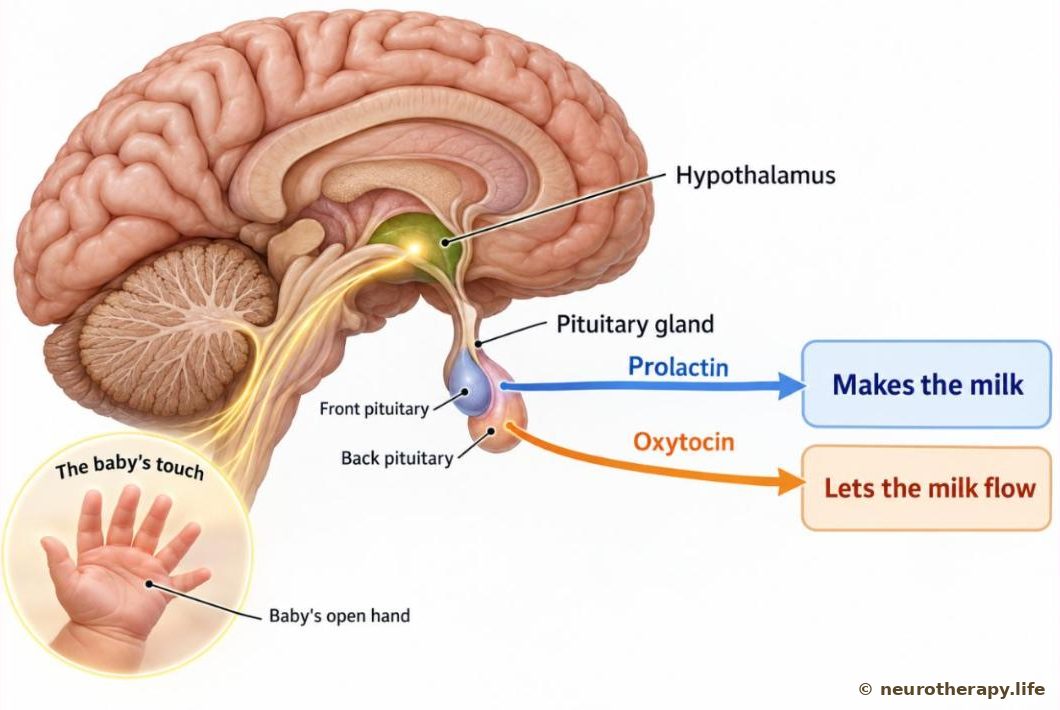
Lactation is the making and flow of a mother's milk after birth. Two hormones sent out from the brain run it — one makes the milk, the other lets it flow when the baby feeds.
- WHO and UNICEF advise starting breastfeeding within 1 hour of birth, only breast milk for the first 6 months, and breastfeeding up to 2 years or beyond
- Worldwide, only about 47 in 100 babies under 6 months get breast milk alone
- A newborn usually feeds 8 to 12 times in 24 hours
- By 5 to 7 days old, a well-fed baby has 6 or more wet nappies a day
Source: WHO (infant and young child feeding fact sheet); American Academy of Pediatrics (HealthyChildren.org); MedlinePlus
What is Lactation (breastfeeding)?
During pregnancy the body prepares the milk glands. After the baby is born, the pituitary — a small gland under the brain — sends out prolactin, which makes the milk.
Making milk is not enough; it also has to flow. When the baby feeds, signals travel from the mother's body to her brain, and oxytocin is released. It makes tiny muscles around the milk glands squeeze, and the milk 'lets down'.
What are the symptoms?
- Signs a baby is getting enough: 8 to 12 feeds a day and 6 or more wet nappies a day by the end of the first week
- Worry signs: fewer wet nappies, dark urine, or a baby who is very sleepy and hard to feed
- A baby who keeps losing weight after the first few days
- In the mother: one area of the breast red, hot, swollen and painful, with fever — this needs a doctor
What causes it, and who is more likely to get it?
What keeps milk coming
- Frequent feeding — the baby's feeding is the signal that brings prolactin and oxytocin
- Skin-to-skin contact and starting feeds within the first hour after birth
What can get in the way
- Long gaps between feeds
- A breast infection (mastitis)
- Some medicines, alcohol and drugs, which can also pass into the milk
How is it found?
There is no single test for lactation. The baby's doctor watches the baby's weight, feeds and nappies, and a lactation consultant can watch a feed and help with how the baby latches.
Baby's weight check
A newborn may lose up to 8–10 in 100 parts of birth weight in the first days and then starts to gain. The first check is within 48 hours of leaving hospital.
Counting feeds and nappies
Writing down feeds, wet nappies and stools for a few days shows whether the baby is getting enough.
Feeding check by a lactation consultant
Watches a full feed and helps with position and latch.
A neurotherapist asks about the mother's health first — especially whether she has thin bones (osteoporosis), because that decides how (4) Para may be given — checks Liv° and Mu° as usual, and makes sure the mother and the baby's doctor know about the treatment.
How Neurotherapy sees Lactation (breastfeeding)
LMNT teaching on lactation is short and centres on oxytocin, the hormone that lets the milk flow. It names two things: the (4) Para point, which stimulates the back part of the pituitary (the posterior pituitary) for oxytocin — and a simple act at every feed that needs no therapist at all.
From a small hand to the flow of milk
- Open handat feeding, the baby's closed fist is gently opened
- Touchthe baby's open hand touches the mother
- Pituitarythe back part of the pituitary releases oxytocin
- Milk flowsoxytocin lets the milk come down to the feeding baby
So in LMNT the mother's own body does most of the work, and the baby helps. The (4) Para point supports the same hormone from the therapist's side.
Neurotherapy treats according to the condition of the body.
Neurotherapy treatment for Lactation (breastfeeding), step by step
Examine first
The therapist checks Liv° and Mu°, asks about the mother's bones and any illness, and about the baby's feeds, weight and nappies. The mother's and the baby's doctors are kept informed.
(4) Para
LMNT teaching gives (4) Para, which stimulates the posterior pituitary for oxytocin — the hormone that lets the milk flow.
Open the baby's hand at every feed
At feeding, the baby's closed fist is gently opened so that its hand touches the mother. In LMNT teaching, that touch helps oxytocin to be released.
Feeding help from the doctor's side
Weight checks, latch and position are looked after by the baby's doctor or a lactation consultant. Neurotherapy only supports alongside them.
Points and formulas used
Never do this
- See a doctor the same day if the mother has a fever with a hot, red, painful or swollen area of the breast. See the baby's doctor at once if the baby has fewer wet nappies, is very sleepy, will not feed, or keeps losing weight.
- In osteoporosis, (4) Para is not given separately by itself. Osteoporosis
- The mother's doctor and the baby's doctor are both told about the treatment. Treatment only by a trained therapist; the baby is not treated in place of a doctor's care.
- Cancer: if the person has cancer, (10) Pan, Thymus, Pit, Lu + Sh, Rt. Ov / Lt. Ov and (30) Medulla are never given — the therapist changes the plan.
- Keep taking the medicines your doctor prescribed. Neurotherapy works alongside your medical care, never instead of it. While breastfeeding, ask your doctor before starting any new medicine, since some pass into the milk.
Watch

This video explains the Para point and how (2) Para differs from (4) Para, in relation to low calcium, bone pain and blood pressure.
This video explains the Para point in general. In lactation LMNT gives (4) Para — and in osteoporosis it is never given alone.
Test yourself
What research says
- Strong evidence
WHO advises skin-to-skin contact between mother and baby right after birth, breastfeeding within the first hour, and breast milk alone for six months. Longer breastfeeding also supports the mother's own health.
World Health Organization. Infant and young child feeding (fact sheet). WHO. 2026.
No clinical trial of Neurotherapy in lactation has been published yet. Improvements reported by neurotherapists are clinical observations.
For you
New mothers
Feed often, keep the baby close, and open the little fist at each feed. If feeding hurts or the baby is not gaining, ask for help early.
Mothers with thin bones
Tell the therapist if you have osteoporosis — in LMNT, (4) Para is then not given by itself.
Families
Help the mother rest, eat and drink, and bring the baby to her for feeds. Watch the nappies and take the baby to the doctor if they fall.
This page explains; it does not diagnose. Neurotherapy works alongside your medical care — keep taking the medicines your doctor prescribed, and see a doctor for any new or severe symptom.